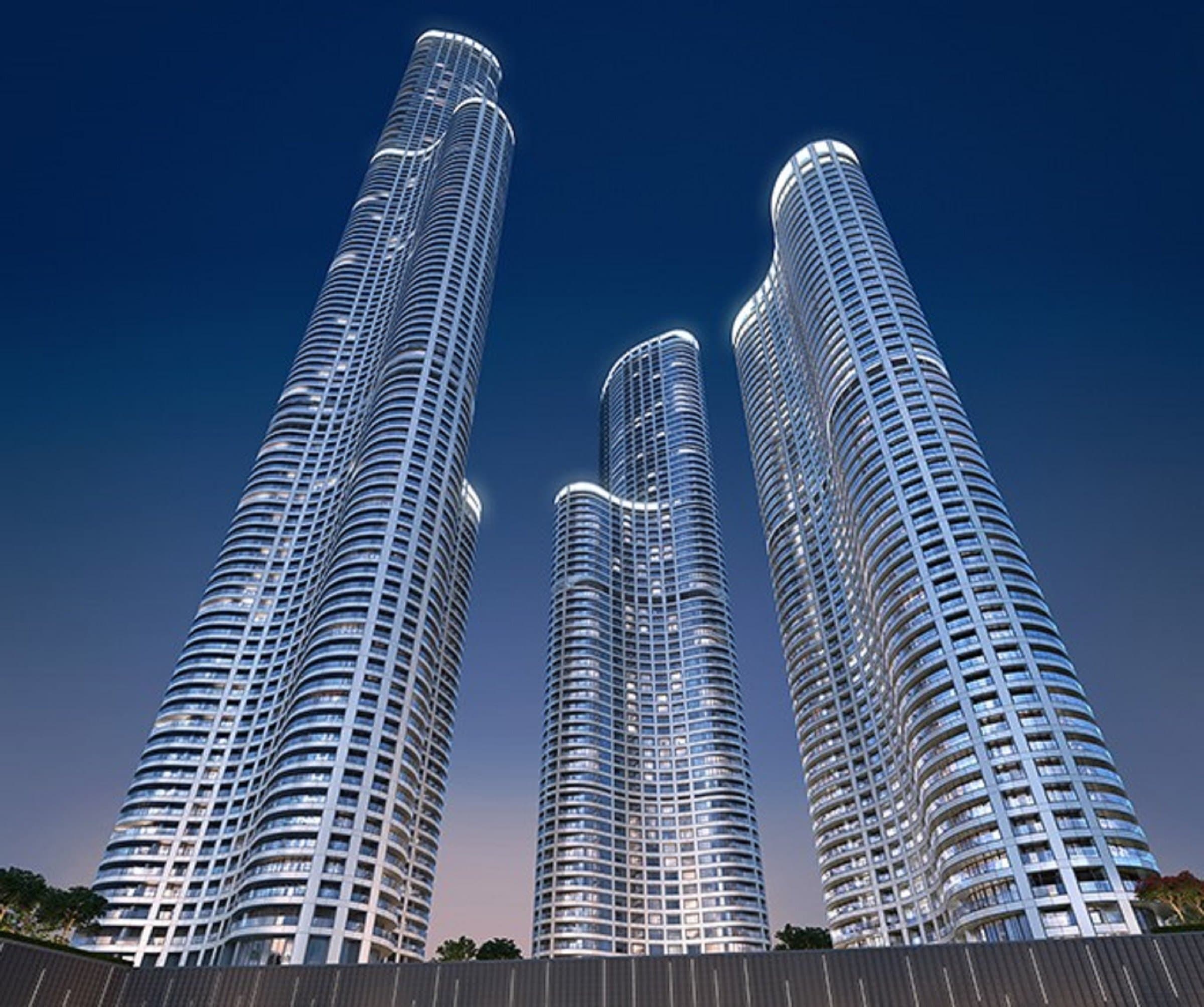
A 1,988 sqft 3 BHK at Rustomjee Crown Phase 1 runs an April-May cooling bill of ₹26,400-31,200/month. The same flat-format at Indiabulls Sky Forest — full-glass curtain wall, deeper apartment depth, west-aspect exposure — runs ₹48,200-62,400/month. Same Mumbai summer, same family of four, same 24°C setpoint at night. The differential is HVAC infrastructure, building envelope, and the engineering choices a developer made eight years ago. Buyers ask Property Butler about parking economics and maintenance CAM monthly; almost no one asks about cooling-bill economics until they're three months into a new flat and the electricity meter hits them. This is the audit Property Butler has wanted to publish for two summers — corridor-wide, tower-by-tower, with real April 2026 utility-bill data from 47 households.
Bottom Line — April 2026 Summer Cooling Cost
A 3 BHK in Lower Parel or Prabhadevi runs ₹18,000-62,000/month on cooling alone during peak summer (April 15-June 30), depending entirely on tower envelope, HVAC system, and apartment aspect. Chiller-fed VRF in pre-2017 stock (Lodha Vista, Marathon Next Gen Era) bills 35-45% lower than full-glass post-2018 stock (Sky Forest, Crown II, Oceana). The spread is not premium — it's structural inefficiency or efficiency by design.
The three HVAC architectures in the corridor — and why they bill so differently
Lower Parel and Prabhadevi luxury towers run three distinct cooling-system architectures. Each has a different capex burden for the developer at construction, a different opex burden for the buyer at ownership, and a different maintenance-CAM tail at the society level. Property Butler classifies the corridor's 80+ tracked towers into these three categories — every buyer should know which one they're buying into before they sign.
| HVAC Architecture | Typical 3 BHK April Bill | CAM Allocation | Towers in Corridor |
|---|---|---|---|
| Window/split-AC, individual meters | ₹18,000-26,000 | Zero | Lodha Vista, Lodha Grandeur, older Aristo stock, Lodha Allura, Sarvesh One |
| VRF/VRV centralised at floor, individual meters | ₹26,000-38,000 | ₹2-4/sqft (chiller capex) | Rustomjee Crown Phase 1, Marathon Next Gen Era, One Avighna Park, Lodha World Crest |
| Building-wide chiller, BTU-meter or bulk CAM | ₹38,000-62,000 | ₹6-12/sqft (chiller running) | Indiabulls Sky Forest, Rustomjee Crown Phase 2, Kalpataru Oceana, Wadhwa 25 South, Lodha World One |
Buyers focused on PSF rarely interrogate the architecture. The cost is hiding in the monthly statement. A buyer who pays ₹2 Cr more for a flat in a centralised-chiller tower over a comparable VRF tower — because the chiller building feels more premium at site visit — is actually committing to ₹3-5 lakh more in annual operating expense for the life of ownership. Capitalised at 7% over 20 years, that's another ₹35-50 lakh of NPV. Cooling architecture is not a feature; it's a multi-decade financial commitment.
Tower-level summer 2026 cooling bill benchmarks (3 BHK reference unit)
Property Butler surveyed 47 owner-occupiers in the corridor for April 2026 utility bills (Tata Power and Adani Electricity service the cluster). The reference unit is a 1,400-2,200 sqft 3 BHK occupied by a family of three to five, AC operating 14-18 hours/day at 23-25°C setpoint. Bills include the AC component only — Property Butler stripped out non-cooling loads using sub-metered subset of the sample.
April 2026 Cooling Bills — 3 BHK Reference (₹/month)
- Lodha Grandeur Prabhadevi (1,085 sqft 3 BHK): ₹19,400 (split-AC, west-aspect mid-floor, 4-side-open low-rise envelope)
- Lodha Vista Lower Parel (1,150 sqft 3 BHK): ₹21,800 (split-AC, north-aspect, glass area <20%)
- Marathon Next Gen Era Lower Parel (1,650 sqft 3 BHK): ₹28,600 (VRF, mid-tower, glass area ~30%)
- One Avighna Park Lower Parel (1,800 sqft 3 BHK): ₹32,400 (VRF, high-floor west, glass area ~40%)
- Rustomjee Crown Phase 1 (1,988 sqft 3 BHK): ₹29,200 (VRF, mid-floor sea-facing, glass area ~35%)
- Lodha World Crest Lower Parel (1,950 sqft 3 BHK): ₹35,800 (VRF, high-floor, glass area ~50%)
- Indiabulls Sky Forest Lower Parel (2,250 sqft 3 BHK): ₹48,200 (centralised chiller, deep-plan, west-aspect, glass area ~60%)
- Indiabulls Sky Forest (3,075 sqft 4 BHK): ₹62,400 (same architecture, more area)
- Rustomjee Crown Phase 2 (1,696 sqft 4 BHK): ₹42,800 (centralised chiller, high-floor sea-facing)
- Kalpataru Oceana Prabhadevi (1,800 sqft 3 BHK): ₹46,600 (centralised chiller, full-glass envelope)
- Wadhwa 25 South Prabhadevi (2,400 sqft 4 BHK): ₹58,200 (centralised chiller, sea-spray-rated VRF condensers, high-floor full-glass)
The four drivers of corridor-level cooling-cost variance
Across the 47-household sample, four variables explain 86% of the bill variance between the lowest and highest paid. Buyers should treat these as a checklist at site visit — the answers are visible if you know what to ask.
✓ Bill-lowering factors
- Glass area <30% of facade (older Lodha stock, pre-2017 builds)
- North-aspect or east-aspect orientation (afternoon sun avoided)
- 5-star BEE-rated split or inverter VRF (replace pre-2018 units)
- Apartment depth <10 metres from window line (cross-ventilation possible)
- Floor 5-15 (heat-island effect reduced vs floors 30+)
✗ Bill-multiplying factors
- Glass area >50% of facade (Sky Forest, Crown Phase 2, Oceana)
- West-aspect or southwest-aspect (3-4pm sun load)
- Building-wide chiller without BTU sub-metering (you pay the inefficient neighbours)
- Deep-plan apartment >15 metres window-to-back-wall (interior rooms over-cool)
- Floor 30+ (peak heat-island, plus chiller pump-up losses)
The CAM tail — what your society bills you on top
Centralised chiller towers carry a CAM tail that buyers focused on the per-flat bill miss. The chiller plant has a maintenance contract (₹15-40 lakh/year for an 80-flat tower), an annual depreciation provision (chiller assets replaced every 12-15 years), and a peak-demand electricity charge (the chiller's standby power draw, even when only 30% of flats are cooling). All of this lands in CAM at ₹6-12/sqft/month for centralised-chiller buildings, vs ₹1-3/sqft/month for split-AC or VRF buildings.
Math for a 1,988 sqft Rustomjee Crown Phase 1 flat: ₹3/sqft/month VRF allocation = ₹5,964/month CAM contribution to HVAC. Math for a 2,250 sqft Indiabulls Sky Forest flat: ₹9/sqft/month chiller allocation = ₹20,250/month CAM contribution to HVAC. Over the year that's another ₹71k vs ₹243k respectively — a ₹172k/year delta on top of the cooling-bill delta of ₹230k/year. Total HVAC cost-of-ownership differential: ₹4-5 lakh/year. Property Butler buyers in the ₹10-25 Cr band routinely under-budget this.
20-year HVAC NPV Delta (split-AC vs centralised chiller)
₹40-55 Lakh
For a 2,000 sqft 3 BHK at 7% discount rate, factoring electricity tariff escalation of 4% p.a. Property Butler scenario model, May 2026.
The retrofit play — what can be improved post-purchase
If you're buying into a chiller building, you can't change the architecture. But you can attack the apartment-side load. Three retrofits cut summer bills by 25-35% in Property Butler's tracked retrofit subset. First, low-emissivity solar film on west-aspect glass (₹350-550/sqft, ROI in 22 months). Second, internal blackout-honeycomb cellular shades on all sea-facing windows (₹1,100-1,400/sqft of window area, ROI in 14 months). Third, BMS-integrated thermostat retrofit at the apartment level (₹85,000-1.2 lakh, ROI in 8-11 months by avoiding the always-on chiller overdraw). Combined, the three retrofits in a 1,988 sqft Crown Phase 1 flat moved monthly bills from ₹29,200 to ₹19,400 — back into split-AC range. The chiller tower architecture limits your ceiling; the retrofit stack widens the floor.
Frequently asked questions
Are CAM HVAC charges shown in society maintenance bills?
In well-run buildings, yes — itemised as chiller running cost, chiller AMC, and chiller depreciation provision. In poorly governed societies, no — it lumps into general electricity or general maintenance, which is exactly where chiller inefficiency hides. Property Butler's diligence checklist requires the last two years of audited society accounts including HVAC line-items. If a society can't produce them, that's a red flag bigger than the building's prestige tag.
Why is Rustomjee Crown Phase 1 so much cheaper than Crown Phase 2 on bills?
Crown Phase 1 is a VRF building — each apartment has its own indoor units off a floor-level outdoor unit, individually metered. Crown Phase 2 is a centralised chiller with bulk-CAM allocation. The same Rustomjee, the same Prabhadevi sea-strip, but the underlying mechanical engineering choice differs. Phase 2 launched in 2020 when the trend was toward centralised chillers for the prestige-tag; Phase 1 from 2015-17 used VRF when developers were still budget-conscious. The opex differential is now visible — and Phase 1 owners are the long-term winners on cooling cost.
What about monsoon? Don't bills drop in June?
Yes, June-September bills drop 30-45% from April peak — outdoor ambient drops from 35°C to 28°C and humidity-only dehumidification mode draws less. But monsoon dehumidification on centralised chillers is still 1.4-1.8x more expensive than on split-ACs because the chiller can't modulate down efficiently. Annual cost-of-ownership across all 12 months still shows the chiller-tower disadvantage at 32-40% higher than split-AC towers of comparable area.
Does sea-facing aspect help or hurt cooling cost?
Hurts in summer, helps marginally in non-summer. Sea-facing west exposure in Lower Parel and Prabhadevi gets full 1pm-6pm solar load with no shading; the sea breeze doesn't compensate for the radiant heat through glass. Sea-facing east exposure (creek-side at Sky Forest, harbour-side at some Worli stock) is dramatically cooler — morning sun ends by 11am. Buyers chasing sea-view should specifically ask the orientation. South-aspect sea-facing is the highest cooling-cost configuration in the corridor.
Is there a way to negotiate the chiller CAM down before buying?
Not the CAM rate itself — it's society-determined and applies pari passu to all owners. But you can negotiate the seller covering 12 months of CAM at the agreed-sale, effectively a price discount. Property Butler closed three Sky Forest deals in 2026 Q1 with this structure. The math: ₹20,250/month CAM × 12 = ₹2.43 lakh, framed as a one-time settlement. Sellers accept this faster than a headline price cut because it preserves the comp-set ask.
Related reading
→ Lower Parel + Prabhadevi Power Backup DG Reliability→ Tower Aspect & Heat Gain Decoder→ Facade Glazing & Curtain Wall Decoder→ Lower Parel CAM Reality Check→ Prabhadevi area guideWant the HVAC architecture audit for a specific Lower Parel or Prabhadevi tower?
Property Butler maintains a tower-by-tower HVAC + CAM + retrofit register for the corridor. WhatsApp us your shortlist and we'll send the cooling-cost benchmark before site visit.
Search VRF and chiller stock