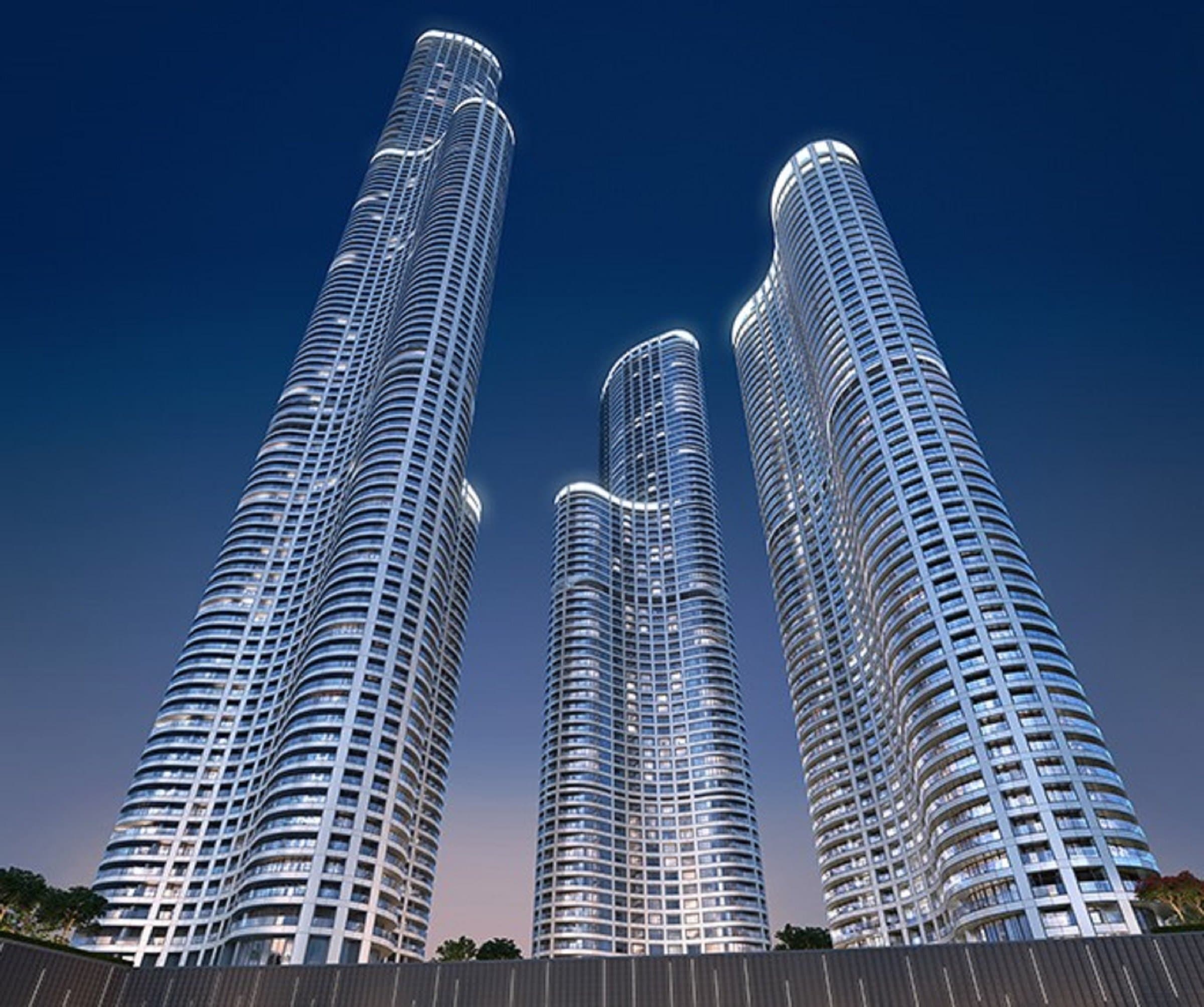
Mumbai's BMC property tax is computed through the Capital Value System (CVS) — a formula-driven assessment that uses the Stamp Duty Ready Reckoner (RR) rate, carpet area, user category, building age, and floor band to arrive at an annual liability. For a Lower Parel or Prabhadevi luxury owner, that translates into ₹95,000 to ₹3.5 lakh per year on a typical 3 BHK to 4 BHK, and the variation is wider than most buyers realise. Property Butler tracks the actual computed liability across reference units in Indiabulls Sky Forest, Lodha World Crest, Rustomjee Crown, Lodha Grandeur, Kalpataru Oceana, and One Avighna Park — and the math, once decomposed, is the most under-discussed recurring cost in the entire Mumbai luxury buying decision.
The headline number
A typical Lower Parel 3 BHK owner pays ₹95,000 to ₹1.6 lakh annually in BMC property tax. A Prabhadevi 3 BHK owner typically pays ₹1.1 lakh to ₹1.9 lakh. A 4 BHK in either corridor runs ₹2.0 lakh to ₹3.5 lakh annually. Over a 10-year hold, that compounds to ₹12-35 lakh — a real recurring cost that most buyers do not factor into their cost-of-ownership calculations.
The Capital Value System formula explained
Under CVS, the BMC property tax is computed as:
Capital Value = Carpet Area (sq.m) × Stamp Duty RR Rate (₹/sq.m) × User Category Factor × Age Factor × Floor Factor
Once the Capital Value is computed, the annual property tax is a percentage of this Capital Value, with the percentage determined by the user category. For residential luxury in Lower Parel and Prabhadevi, the effective tax rate typically lands between 0.30% and 0.45% of Capital Value, depending on amenity classification, age band, and use category.
The Stamp Duty Ready Reckoner rate is published annually by the Inspector General of Registration. For 2026, the indicative ready reckoner rates for premium residential in Lower Parel sit at ₹3.40-4.20 lakh per sq.m, and in Prabhadevi at ₹4.10-5.40 lakh per sq.m. These are the floor for property tax computation, not the asking price — actual market PSF runs significantly higher than RR rates.
The user category and age multipliers that change the outcome
The CVS user category factor is the first place errors creep in. Residential properties carry one factor, residential-plus-commercial mixed-use buildings carry another, and pure commercial carries the highest. Lower Parel's mill-land conversion legacy means several buildings classify as mixed-use — and the residential units in those buildings can occasionally be tagged with the mixed-use multiplier, increasing the effective tax. A clean diligence check before buying is to request the latest BMC property tax bill from the seller and verify the user category coding.
The age factor adjusts for building depreciation. Buildings less than 5 years old carry the full 1.00 multiplier (full Capital Value). Buildings 5-10 years carry 0.95, 10-20 years carry 0.85, 20-30 years carry 0.75, and beyond that step down further. This means a brand-new tower like Rustomjee Crown Phase II or Lodha Grandeur carries the maximum age multiplier, while older Lower Parel mill-land conversions in the 12-15 year band benefit from a 0.85 multiplier — translating to roughly 15% lower property tax for the same Capital Value carpet.
The floor factor is the smallest of the three but is non-zero. Floors above the 30th band carry a marginal premium (1.05-1.10) versus mid-floors. For a 4 BHK on the 45th floor of Indiabulls Sky Forest, the floor factor adds roughly 5-8% to the property tax compared to an identical unit on the 12th floor. Most luxury buyers do not internalise this — but it is a real recurring cost.
Typical annual outflow on a Lower Parel 3 BHK
Take a representative Lower Parel 3 BHK at Indiabulls Sky Forest — 1,800 sqft (167 sq.m) carpet, 35th floor, 12-year-old building, residential category. The CVS math runs:
- Carpet 167 sq.m × RR rate ₹3.85 lakh/sq.m = Capital Value before adjustments: ₹6.43 Cr
- User category factor (residential): 1.0
- Age factor (10-20 year band): 0.85 → ₹5.47 Cr
- Floor factor (high floor): 1.05 → ₹5.74 Cr Capital Value
- Annual property tax at ~0.32% effective rate: ₹1.84 lakh per year
For a comparable 1,335 sqft Prabhadevi 3 BHK at Rustomjee Crown Phase I, the math runs differently because the RR rate is higher and the building is newer. RR rate ₹4.85 lakh/sq.m × 124 sq.m = ₹6.01 Cr Capital Value before adjustments. Apply 0.95 age factor and 1.0 floor factor for a mid-band unit, and the effective Capital Value is ₹5.71 Cr. At 0.30%, the annual tax lands at ₹1.71 lakh.
The two are surprisingly close in absolute terms, even though the asking PSFs are very different — because the BMC Capital Value System uses ready reckoner rates, not market rates. For the BMC, both addresses sit in the same approximate liability band.
| Reference unit | Carpet | Indicative annual tax | 10-yr cumulative |
|---|---|---|---|
| LP 2 BHK (~750 sqft) | ~70 sq.m | ₹70,000-85,000 | ~₹8 lakh |
| LP 3 BHK Sky Forest (~1,800 sqft) | ~167 sq.m | ₹1.7-1.95 lakh | ~₹19 lakh |
| PD 3 BHK Crown (~1,335 sqft) | ~124 sq.m | ₹1.55-1.85 lakh | ~₹17 lakh |
| LP 4 BHK World Crest (~2,200 sqft) | ~204 sq.m | ₹2.4-2.8 lakh | ~₹26 lakh |
| PD 4 BHK Oceana (~2,100 sqft) | ~195 sq.m | ₹2.6-3.1 lakh | ~₹29 lakh |
| LP 5 BHK Avighna Park (~3,500 sqft) | ~325 sq.m | ₹3.0-3.5 lakh | ~₹33 lakh |
What every owner should diligence in the bill
Three line items go wrong most often in BMC property tax bills, and a quarterly check is worth the half hour it takes:
- Carpet area mismatch. The BMC bill carpet area should match the registered sale deed carpet area. Builder-provided saleable area is irrelevant to BMC. If the bill carpet is overstated, the tax is overstated proportionally.
- User category misclassification. Residential units occasionally get tagged with mixed-use multipliers in mill-land buildings. A correction request through the BMC Assessor and Collector ward office can save 8-15% annually.
- Age factor not stepped down. Buildings that should have moved into the 10-20 year band sometimes still carry the under-5-year multiplier on the BMC's records because age updates are not always automated. A formal age verification request can recover the 0.85 multiplier and save 10-15% annually going forward.
10-Year BMC Tax (typical 4 BHK)
₹26 lakh - ₹35 lakh
Recurring annual cost most buyers underweight at purchase
Discounts and waivers worth claiming
Three waivers and discounts are routinely available but underclaimed in this corridor:
- Early payment discount: BMC offers a 2-5% discount on the annual tax if paid in full by the early-payment cut-off (typically end of June). On a ₹2 lakh annual liability, that is ₹4,000-10,000 — small per year, meaningful over a decade.
- Owner-occupancy discount: certain BMC schemes offer modest reductions for owner-occupied versus rented units. The discount is small but should be claimed in the bill if applicable.
- Senior citizen rebate: where the title is in the name of a senior citizen or jointly held with one, BMC has occasional senior-citizen schemes. Verify each year through your housing society or directly with the ward office.
RR rate trajectory and what it means going forward
BMC and Maharashtra Stamp Duty's ready reckoner rates are revised annually. For 2026, residential RR rates in premium SoBo zones moved up by approximately 4-7% over 2025. Lower Parel and Prabhadevi both saw mid-single-digit RR increases. This translates directly into property tax increases of similar magnitude on the same property. Over a 10-year hold, with average 5% annual RR rate growth, the property tax compounds at a rate that should be modelled as part of cost-of-ownership — not assumed flat.
The RR rate adjustments matter especially for buyers who plan to use the property as a rental investment. The yield calculation should explicitly subtract property tax from gross rental income before the gross-yield headline is taken seriously. A typical Lower Parel 3 BHK rental yield drops from 1.7% gross to ~1.5% net once property tax and CAM are subtracted; for Prabhadevi the drop is similar.
Frequently asked questions
Why does the BMC use Capital Value, not market rate?
Capital Value is anchored to the Stamp Duty Ready Reckoner — a state-published, audited rate used for stamp duty registration. Tying property tax to RR rate ensures consistent, contestable assessment that does not chase volatile market price movements. The trade-off is that BMC tax lags actual market prices by 12-30 months in rising markets and overshoots in falling markets, but the consistency is generally accepted as worth the lag.
Can BMC property tax be deducted from rental income for income tax?
Yes. Under Section 23 of the Income Tax Act, municipal taxes paid in the year are deductible from gross annual rental value to arrive at Net Annual Value, which then has the standard 30% deduction applied under Section 24. For an active rental investor in Lower Parel or Prabhadevi, the BMC tax is one of the cleaner deductible expenses — keep the BMC bill and bank payment proof together for filing.
What if I buy a unit and the seller has unpaid BMC tax dues?
BMC dues attach to the property, not to the seller. Buying a unit with unpaid tax dues makes the new owner liable for back taxes plus penalty interest. A pre-purchase BMC dues check is a 30-minute exercise through the BMC e-portal and should be a non-negotiable part of any Lower Parel or Prabhadevi luxury closing. Property Butler's diligence checklist includes this verification by default.
Is the property tax higher in Lower Parel or Prabhadevi?
For comparable carpet area and age, Prabhadevi runs marginally higher because its RR rates are higher (₹4.10-5.40 lakh/sq.m versus Lower Parel's ₹3.40-4.20 lakh/sq.m). On a 3 BHK basis, Prabhadevi typically tracks 8-15% more in absolute property tax for a similar-vintage building. The gap narrows on older Lower Parel mill-land conversions because their age multiplier helps.
How often does BMC actually update Capital Value records?
RR rate updates happen annually. Capital Value updates on the actual bill happen with each annual revision cycle, but corrections (carpet area, user category, age) require owner-initiated request. If the building has been retrofitted or amenity additions have been made, the BMC may issue a Capital Value adjustment based on inspection — these are infrequent but happen. Owners should verify the bill components annually to catch errors early.
Related Reading
→ Real Buyer Cost — Stamp Duty + GST in LP/PD → Lower Parel & Prabhadevi Income Tax Stack → Lower Parel CAM Maintenance Cost Reality Check → Lower Parel Rental Yield Furnished vs Bare Shell → Jumbo Home Loan Structuring for LP/PD Luxury → Lower Parel Area GuideDecoding the real cost of owning Lower Parel or Prabhadevi luxury
Property Butler's relationship managers walk every buyer through carpet, BMC tax, CAM, GST, and home loan EMI before commitment. See active inventory and full ownership cost breakdowns.
Search Lower Parel & Prabhadevi