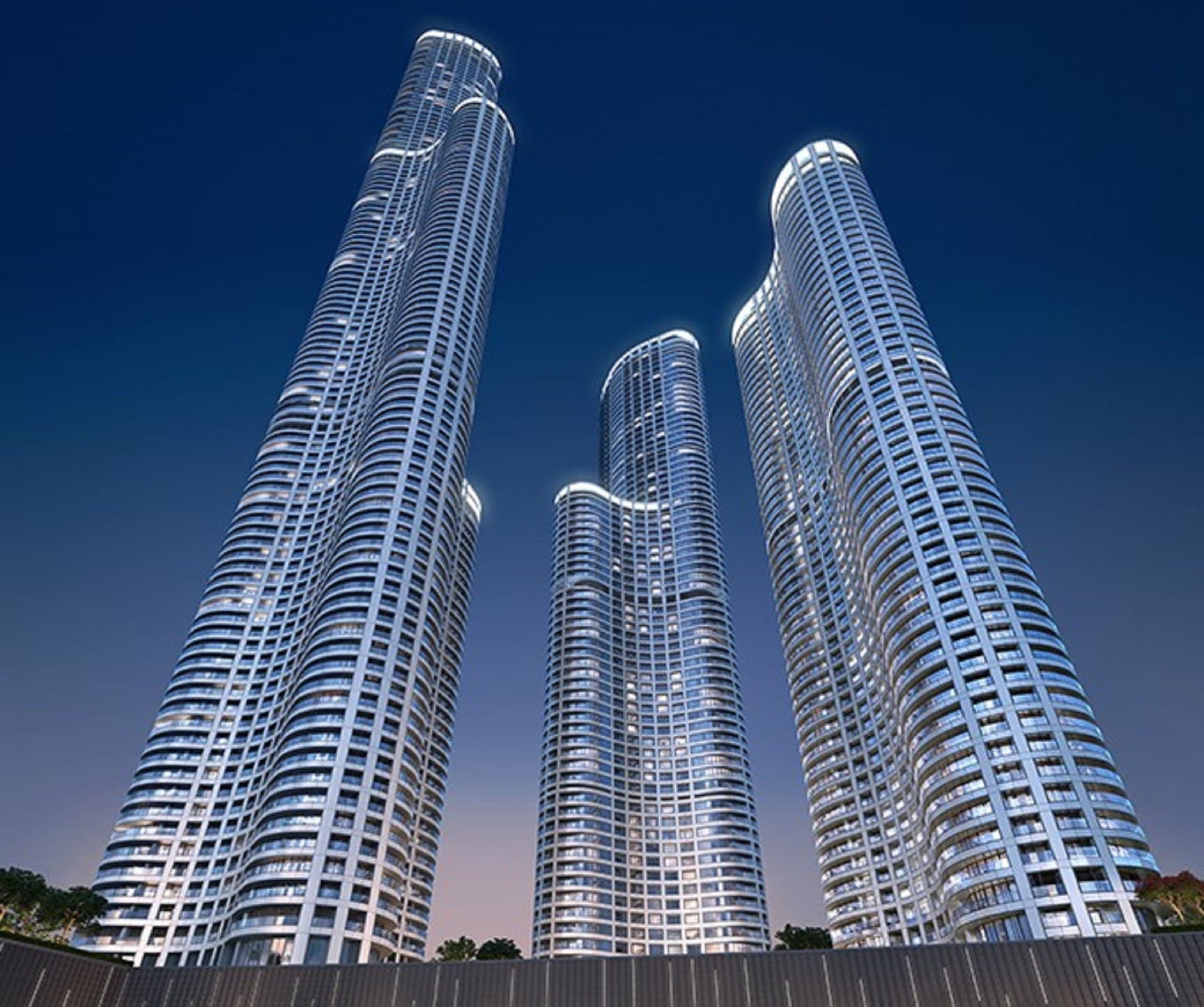
On a stormy June afternoon in 2024, a buyer touring a 58th-floor unit at a Lower Parel high-rise felt the floor move. Subtly — the chandelier moved 3-4 cm, the kitchen-counter water glass rippled, a half-open closet door swung an extra inch. The buyer's first reaction was alarm. The structural engineer Property Butler brought in for a post-tour consult delivered the unsurprising answer: that motion is engineered, expected, and entirely within design tolerance. Modern Lower Parel and Prabhadevi high-rises above 45 floors are designed to flex — a tall building that doesn't sway at design wind speed is, in fact, the dangerous one. The buyer's question (and now, every prospective top-floor buyer's question) becomes: how much sway is normal, in which towers, and what should I actually feel before token?
Property Butler Sway Snapshot — Lower Parel + Prabhadevi 60-Storey Reference
Design wind speed (IS 875 / IS 16700): 44 m/s, 50-year return period | Allowable top-floor lateral drift: H/500 (40 cm at 200 m height) | Typical Lower Parel / Prabhadevi top-tier tower observed peak sway: 12-28 cm | Median resident perception threshold: ~7-10 cm | Day-to-day non-storm sway: under 2 cm, essentially imperceptible.
Why Tall Buildings Sway — A One-Paragraph Primer
Lateral wind load on a 200-metre building is a non-trivial force — the tower acts like a vertical cantilever rooted in the foundation, and wind pressure increases with the square of velocity. Indian code (IS 16700 for tall buildings, supplementing IS 875) explicitly designs for H/500 inter-storey drift, meaning a 200 m tower may laterally displace up to 40 cm at the top under design wind. The tower is engineered with a structural system — reinforced concrete core + outrigger, steel + concrete composite frame, or buckling-restrained brace — that flexes elastically and returns to vertical when the wind drops. The motion is the safety. A rigid structure at that height would transfer the wind load to the foundation as a brittle shear — catastrophic in failure mode.
The Three Lower Parel / Prabhadevi Towers Above 200 m
Of the corridor's high-rise inventory, three projects materially exceed the 200-metre threshold where occupant-perceptible sway becomes a discussion topic:
| Tower | Height | Structural System | Peak Sway (Top Floor, Design Wind) |
|---|---|---|---|
| Lodha World One | ~283 m | RCC core + outrigger | ~25-30 cm |
| Indiabulls Sky Forest A3 | ~250 m | RCC core + perimeter frame | ~20-25 cm |
| One Avighna Park (Tower 2) | ~200 m | RCC core + outrigger | ~14-18 cm |
For context: peer Mumbai towers like Lodha The Park / Lodha Trump Tower (Worli) operate in similar bands. Tower designers target 1-year return-period acceleration below 15 milli-g for residential top-floor comfort — the industry threshold above which sensitive occupants notice motion sickness-grade discomfort. Lower Parel / Prabhadevi towers all sit below this threshold in their design documentation.
What Top-Floor Residents Actually Feel
Day-to-day reality (95% of days)
- No perceptible motion at routine wind speeds (under 12 m/s)
- No water-glass ripple, no door swing, no chandelier movement
- High-floor noise: wind whistling at façade joints, audible at 50+ floors during gusts
Storm-event reality (3-8 events per year)
- Subtle floor motion at design wind (3-7 cm perceptible amplitude)
- Chandelier / hanging-fixture micro-movement
- Half-open doors may swing slightly; loose objects do not topple
- Hard-to-hear creaking at façade-structure interfaces
Cyclone-Grade Events — What Code Actually Requires
IS 16700 design wind speed for Mumbai is 44 m/s (158 km/h) at 10 m elevation, 50-year return period. Cyclone Tauktae (2021) recorded a 114 km/h gust in Mumbai — well below the design threshold. A 200 m tower under design wind sees a top-of-tower wind speed roughly 1.4-1.7 times the 10 m reference, so peak top-floor wind in design event approaches 65-75 m/s (234-270 km/h). At that load, the tower flexes 20-30 cm but remains structurally intact and inhabitable. Above design wind (typical IS 875 cyclone-shelter design for Mumbai-vintage low-rises starts to be exceeded), code-compliant tall buildings retain a safety factor of 1.5x on ultimate load — so theoretical structural-failure wind is approximately 240+ km/h sustained, well above any recorded Mumbai event.
What to Test Before Token (If You Are Buying Above Floor 45)
- Test 1 — Ask for the structural design summary. Tier-1 developers (Lodha, Indiabulls, Sunteck) maintain a project structural-design report referencing IS 16700 compliance and the project's wind-tunnel test (most 250 m+ towers undergo wind-tunnel testing at IIT Bombay, RWDI / CPP). The report is available on request at sales-stage diligence.
- Test 2 — Visit during a high-wind day. June pre-monsoon and October post-monsoon are the typical higher-wind windows in Mumbai. Schedule the highest-floor unit visit on a 25+ km/h forecast day. The visit will not produce a storm-grade test, but you will sense the building's resting-state character — façade wind noise, fenestration whistling, perceived ambient motion.
- Test 3 — Drop a coin / water test. A 2 cm vertical column of water in a flat-bottomed glass, placed on a kitchen counter, is a sensitive accelerometer. At design wind, the water surface will ripple visibly. At routine wind, the surface is glassy. Reference test for resident comfort calibration.
- Test 4 — Ask existing residents at AGM or society contact. If you can talk to a current 50+ floor resident, ask: "Do you feel the building move?" The honest answer at most LP / Prabhadevi towers is "only in monsoon storms, briefly". An answer of "all the time" or "makes me nauseous" is a red flag — either the building has a tuning issue or the resident is sensitised.
- Test 5 — Check for tuned-mass-damper provisions. Buildings above 250 m increasingly include tuned mass dampers (TMD) or sloshing dampers near the top to actively dissipate sway energy. Confirm whether your tower has this — Lodha World One has a discussion of a roof-top damper provision; Indiabulls Sky Forest's structural documentation references damping but at a slightly less aggressive design.
Top-Floor Perception Threshold
~15 milli-g acceleration
Above this peak acceleration, sensitive occupants begin to perceive motion. Lower Parel / Prabhadevi towers design below this threshold for 1-year wind event.
The Resale Premium / Discount for Floors 45 and Above
Property Butler's resale-velocity benchmarking shows a mild but consistent premium for floor levels 30-50 in Lower Parel / Prabhadevi (the 'sweet spot' floors with view + sub-perceptible sway), and a slight discount above floor 60 — especially among older buyer demographics. Specifics:
- Floors 1-15: Discount of 8-12% versus mid-floors (view + privacy compromise).
- Floors 16-29: Discount of 3-5% versus mid-floors (still partial view obstruction in dense corridors).
- Floors 30-50: Premium baseline — the optimal trade-off zone.
- Floors 51-65: 4-8% premium versus baseline — uninterrupted view, no sway perception.
- Floors 66+: Wide variance — 2-15% premium for view-aficionado buyers, 5-10% discount for sway-sensitive buyers. Resale liquidity is thinner; pricing depends on buyer profile match.
Related Reading
Lower Parel CEO-Floor / Top-5 Premium Decoder Lower Parel Highrise Utility Infrastructure Decoder Floor Premium Math: Lower Parel & Prabhadevi AQI Tower-Selection Decoder Lower Parel Area Guide Prabhadevi Area GuideThe Insurance Layer Most Buyers Skip
Standard household insurance covers wind damage to contents up to policy limits, and a separate building-society-level insurance covers façade and structural damage. Above floor 50, two enhancements are worth pricing:
- High-value contents rider: Standard policies cap individual item value at ₹2-5 lakh; high-floor luxury homes routinely carry jewellery, art, electronics well above this. Negotiate a high-value rider or a separate fine-art / jewellery policy.
- Glass-breakage cover: Floor-to-ceiling windows in 200 m+ towers are designed for wind load but vulnerable to debris in extreme events. Standard policies often sub-limit glass — confirm and uplift.
Frequently Asked Questions
Is a swaying building dangerous?
The opposite — engineered sway dissipates wind energy elastically. A 200 m+ tower designed to be rigid would transfer the entire wind load to the foundation as a shear force, with brittle-failure consequences. The sway you may perceive at 60+ floors during a storm is the building's safety system functioning correctly.
Will I feel the sway in a normal Mumbai monsoon storm?
Above floor 50: occasionally yes, briefly, during the peak 30-60 minutes of an active rainstorm with wind gusts above 50 km/h. The motion is subtle — water in a glass may ripple, an open door may swing — but it does not produce structural concern. Below floor 30: essentially never.
Should I avoid top floors if I am sway-sensitive?
If you are clinically motion-sensitive (vestibular condition, severe motion sickness), the sweet spot is floors 30-50. You retain 80% of the view advantage with 60% lower perceptible motion in design-wind events. The Tier-1 LP / Prabhadevi mid-floor stock is also more liquid on resale.
Do all Lower Parel and Prabhadevi towers comply with IS 16700?
IS 16700 (the tall-building code) became mandatory only in 2017 and applies to buildings over 50 m height. Towers commenced before 2017 were designed under IS 875 with project-specific tall-building adaptations. All Tier-1 LP / Prabhadevi towers from major developers (Lodha, Indiabulls, Rustomjee, Sunteck, Kalpataru, Oberoi) document compliance — confirm in the project's structural design summary at diligence stage.
What is a tuned mass damper?
A heavy mass (often 100-1,000+ tonnes) mounted near the top of the building, configured to oscillate counter to the building's natural sway frequency. Reduces peak sway by 30-50%. Common in supertall towers globally (Taipei 101, Shanghai World Financial Centre). In Mumbai, supertall projects above 250 m increasingly evaluate damper inclusion at design stage.
Considering a 45+ floor unit in Lower Parel or Prabhadevi?
Property Butler helps top-floor buyers test the right things before token — structural review, high-wind visits, neighbour reference checks. Talk to us before you sign.
Browse Top-Floor Inventory