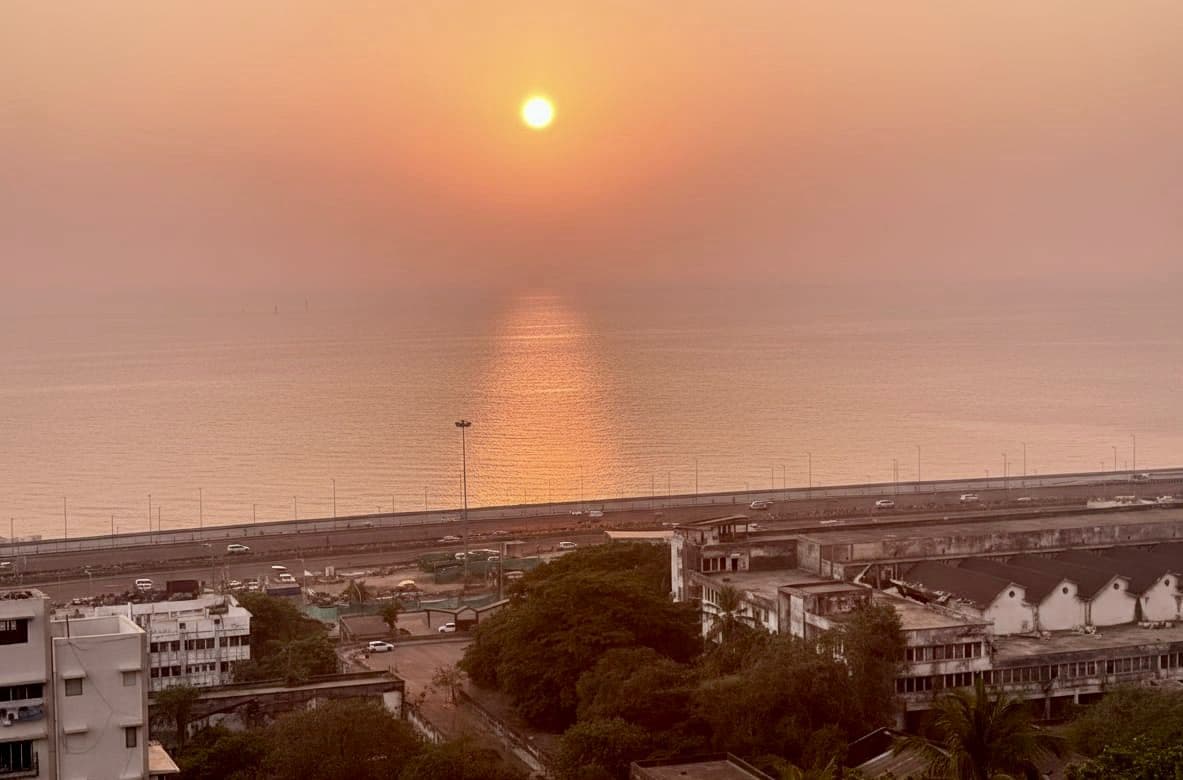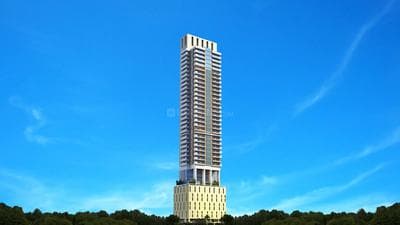
A 76th-floor flat at Lodha The Park asks ₹65,261 / sqft. The same building's 9th-floor stack asks ₹54,000. Most buyers attribute the spread to view and prestige. Half of it is — but the other half is hidden physics: above the 50th floor in a Worli sea-front tower, you experience wind. Some towers handle it invisibly. Others don't. Property Butler's structural research has decoded which is which.
Property Butler's perceptibility threshold
Lateral acceleration above 15 milli-g is when the human body starts noticing tower sway as a wobble or floor drift. Worli's tallest residential towers, designed to ISO 6897 and IS 875-Part 3, target peak acceleration of 10 - 22 milli-g in 50-year wind. The differential between best-in-class and average is a real lifestyle variable above floor 50 — and a real safety variable for HNI buyers with antique furniture, chandeliers, or aquariums.
The wind environment Worli high-rises actually face
Worli sits at the southern lip of Mahim Bay, perpendicular to the prevailing southwest monsoon. Between June and September, average wind speed at 200m elevation is 18 - 24 m/s with peak gusts crossing 32 m/s during pre-monsoon depression events. October cyclonic systems (Tauktae 2021, Asna 2024) push 50-year design wind to 47 m/s on the building face — the loading number that drives structural design.
What this means in practice: a 250m tower at Worli sea-face with rectangular plan and average aerodynamic coefficient of 1.3 experiences peak base moment of roughly 240,000 kN·m in a 50-year storm. That moment must be absorbed by the structural system without inducing perceptible sway. The four mechanisms used: (1) increased structural stiffness, (2) damping ratio engineering, (3) tuned mass dampers, (4) aerodynamic shape optimisation.
The five structural systems used in Worli high-rises
| System | Worli example | Sway character |
|---|---|---|
| Outrigger + Belt Truss | Lodha World One, Lodha Trump | 8 - 12 milli-g (excellent) |
| Diagrid + Core | Lodha World Crest | 10 - 14 milli-g (very good) |
| Tube-in-Tube | Indiabulls Blu, Lodha Adrina | 12 - 16 milli-g (good) |
| Shear Wall + Coupled Beam | Older Worli high-rises (pre-2015) | 15 - 22 milli-g (perceptible) |
| Composite Mega-Frame + TMD | Birla Niyaara, Prestige Nautilus | 7 - 10 milli-g (best-in-class) |
The post-2020 generation of Worli high-rises (Birla Niyaara, Prestige Nautilus, Godrej Trilogy, Aakasa) have moved decisively toward composite mega-frame systems with tuned mass dampers — the same family of solutions used at Burj Khalifa and 432 Park Avenue. The result: occupants on the 50th+ floor barely register a 50-year wind event. Older towers without dampers will sway 2 - 3x more, and you'll know.
What is a tuned mass damper, in plain terms
A massive concrete or steel block (typically 400 - 1,000 tonnes) suspended near the top of the building on viscous oil dampers and counter-springs. When the tower sways one way in wind, the damper mass lags slightly and pulls back the other way — counter-phase motion that bleeds energy out of the building's natural oscillation. Reduces peak acceleration by 30 - 50%.
Property Butler's structural research desk has confirmed installed TMDs in 4 active Worli developments, with 3 more specified in under-construction towers. Buildings without TMDs rely on inherent damping (typically 1.5 - 2.5% of critical) and structural stiffness alone. Both work — but TMD-equipped towers feel demonstrably more solid above the 50th floor.
✓ What good wind engineering looks like
- Wind tunnel test report (RWDI or CPP)
- Peak acceleration < 15 milli-g (50-yr return)
- Structural damping ≥ 2.5%
- Aerodynamic shaping (chamfered corners, setbacks)
- Tuned mass damper above floor 60
✗ Warning signs to surface in due diligence
- No wind tunnel report disclosed
- Tower above 200m without TMD
- Boxy plan + sharp corners (vortex shedding)
- Slenderness ratio > 8:1 without compensation
- Existing residents report swing in storms
The lifestyle implications buyers underestimate
The 22 milli-g peak acceleration in an older Worli tower is well within structural safety margins. Building won't fall, won't crack. But occupants on the 60th floor will experience three real things during peak monsoon storms:
- Visible water sloshing in pools and aquariums: a sky-deck infinity pool will show standing wave patterns that don't go away for hours. Indoor aquariums lose 2 - 4cm of water depth to sloshing in heavy gusts. HNI clients with rare fish report this regularly.
- Chandelier swing: 1 - 3cm visible motion in any heavy hanging fixture. Antique chandeliers worth ₹15 - 50 L need to be either rewired into rigid mounts or removed in towers with high acceleration scores.
- Door auto-close from pressure differential: wind loading on building face creates internal pressure gradients. Doors held open by stoppers swing slowly closed during storms — not sway, but pressure-driven motion. Common complaint in pre-2018 high-rises.
None of this is a deal-breaker. But it changes the cost-of-living profile and influences which floor you buy on. Property Butler's recommendation for HNI buyers prioritising stillness: stay below floor 45 in pre-2015 towers, or pay the premium for post-2020 TMD-equipped buildings if you want floor 60+.
Worli high-rise stack premium
+18 - 28% PSF
Floor 60+ vs floor 20 in same tower (Property Butler tracked Worli inventory)
The wind tunnel report — what to ask for
Every Worli tower above 100m should have a wind tunnel study performed by an independent boundary-layer wind tunnel facility. The standard providers in India are RWDI (Toronto-based, Mumbai office), CPP (Colorado), and BMT (UK). The report typically includes:
- 50-year and 100-year peak wind pressures on facade
- Across-wind and along-wind base moments
- Top-floor peak acceleration (in milli-g) for 1, 5, 10, 50-year return periods
- Pedestrian-level wind comfort study at podium and entry plaza
- Cladding wind pressures (for facade design)
A reputable developer will share the executive summary — the full report is usually 200+ pages. If a developer refuses to share even the summary, that's a meaningful flag. Property Butler has secured wind tunnel summaries for every active Worli high-rise above 150m and uses them in pre-purchase advisory.
Frequently Asked Questions
Is sway a safety risk or just a comfort issue?
For the structure: not a safety risk. Indian codes IS 875-Part 3 and DCPR 2034 enforce structural margins well above ultimate limit state for any approved Worli high-rise. For occupants: sway becomes a comfort issue around 15 milli-g and a noticeable lifestyle issue above 20 milli-g. For sensitive interiors (aquariums, chandeliers, art): even 12 milli-g triggers visible motion. Choose floor and tower accordingly.
Do tuned mass dampers need maintenance?
Yes — viscous oil dampers and tuning springs require inspection every 24 months. Cost is borne by the society maintenance budget, typically ₹3 - ₹6 L per inspection cycle for a 600-tonne TMD. This is well-spent capital — a non-functional damper is just dead weight at the top of the building. Verify the AMC contract during your due diligence.
Why do older Worli towers sway more than newer ones?
Three reasons: (1) computational fluid dynamics + wind tunnel testing has matured dramatically since 2018, so newer designs are aerodynamically optimised in ways pre-2015 towers couldn't be, (2) post-2020 towers routinely include TMDs whereas only 2 pre-2018 Worli towers do, (3) high-strength concrete (M80, M100) used in newer towers achieves higher stiffness with less mass — better ratio for sway control. The technology gap is real and translates into livability.
Should this affect my floor selection?
In an older Worli high-rise (pre-2015), Property Butler typically recommends staying below the 45th floor unless the buyer specifically wants the view premium and is comfortable with sway. In a post-2020 TMD-equipped tower, the entire stack above floor 50 is usable without compromise. The wind issue is one reason floor selection can't be a generic rule — it depends on the structural system of the specific tower.
Related Reading
→ Best Floor to Buy in Worli High-Rises — PSF Analysis → Worli Construction Quality Benchmark → Worli Mid-Floor Sweet Spot Pricing Analysis → Worli Microclimate, Noise & Air Quality by Tower Position → Worli Area GuideConsidering a top-floor Worli flat?
Property Butler walks through wind tunnel summaries, sway scores, and TMD specifications building-by-building before you commit to a sky-stack flat.
Search Worli High-Floor Inventory