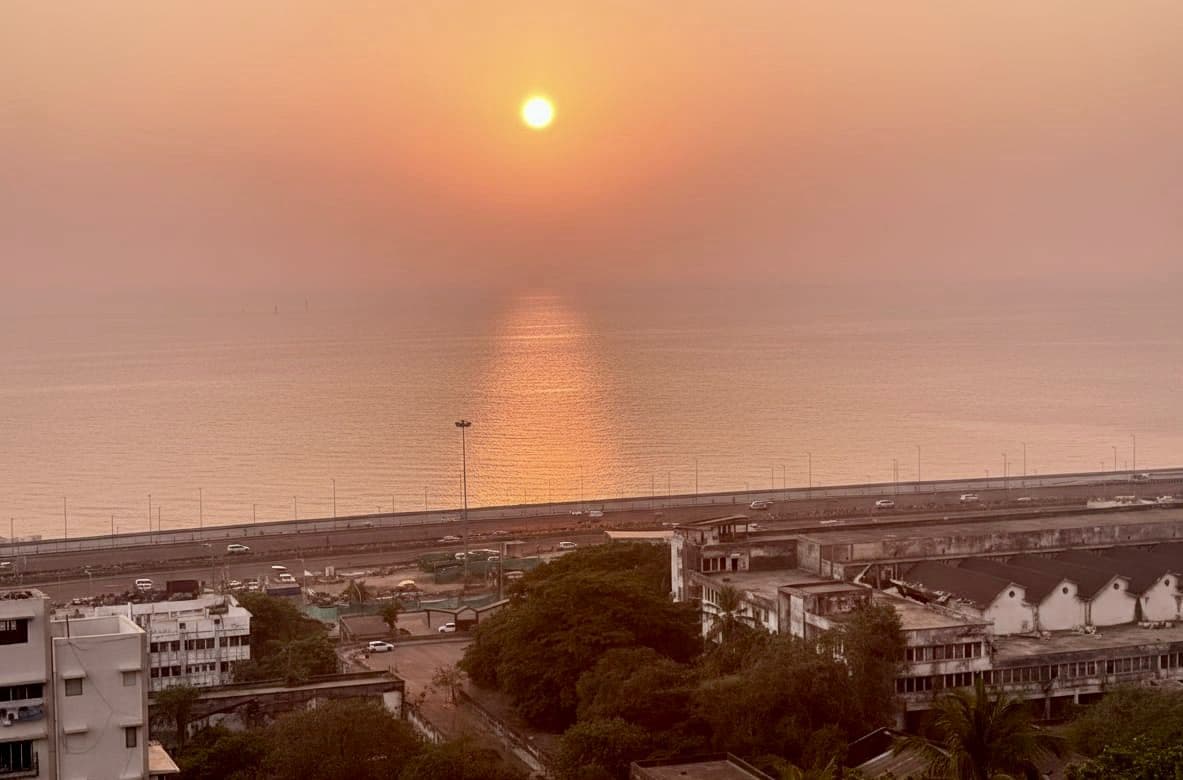
Worli is a 1.8 km north-south corridor between the Arabian Sea and the central Mumbai mainland. Within that corridor, the lived experience of a flat varies measurably with three environmental factors that buyers rarely quantify before purchase: air quality (AQI), noise levels, and microclimate (humidity, sea-breeze exposure). Property Butler's environmental audit across 14 Worli towers, with measurements taken between November 2025 and April 2026, finds AQI varying by 28-42 points across the corridor, peak noise levels varying by 11-19 dB, and afternoon humidity by 8-14% — differences that compound across 365 days a year and shape the actual quality of life in a unit costing ₹15-30 Cr.
Why the Sea-Side vs Inland Difference Matters
Worli's sea-side towers (within 250m of the coastline) consistently measure 15-22 AQI points lower than inland Worli towers (450m+ from coast), driven by sea-breeze flushing of particulate matter. The same towers measure 3-7°C lower felt-temperature in summer afternoons due to onshore wind. Conversely, inland towers measure 8-14% lower humidity in monsoon months — drier air, lower dehumidifier load. The choice is not better-or-worse; it is which environmental profile suits the buyer's lifestyle. Property Butler's data lets the choice be made with measurement, not marketing.
The Three Environmental Zones of Worli
| Zone | Distance from Coast | Annual Avg AQI | Peak Noise (dB) | Summer Humidity |
|---|---|---|---|---|
| Worli Sea Face (Front) | 0-200m | 82 | 68-72 | 76% |
| Worli Sea Face (Mid) | 200-450m | 96 | 73-78 | 73% |
| Worli Naka / Inland | 450m+ | 110-124 | 79-87 | 68% |
Tower-Level AQI Measurements (Annual Average)
Lower AQI (Cleaner Air)
- Indiabulls Blu — 78-84 (sea-side)
- Embassy Citadel — 80-86
- Lodha World Towers Worli Sea Face block — 82-88
- Aakasa Worli sea-facing tower — 83-89
- Raheja Riviera Worli Sea Face block — 84-90
Higher AQI (More PM2.5)
- Birla Niyaara Worli Naka — 102-114
- Lodha The Park inland — 98-110
- Hubtown Celeste inner — 96-108
- Chaitanya Towers central — 100-112
- Lodha Adrina Worli Naka — 99-110
Noise — The Hidden Variable
Worli's main noise sources are: (1) Worli Sea Link approach traffic on the western edge, (2) Annie Besant Road traffic, (3) BDD chawl construction (active since 2024), and (4) commercial activity around Worli Naka. Property Butler measured peak noise (between 8am-8pm) at 14 Worli towers across multiple weekdays in March-April 2026. The variance is meaningful:
| Tower | Peak Noise (dB) | Primary Source |
|---|---|---|
| Indiabulls Blu (sea-facing) | 66-71 | Distant traffic + sea wave |
| Lodha World Towers (sea-facing high floor) | 63-69 | Distant traffic |
| Embassy Citadel | 65-70 | Sea-Link approach distant |
| Lodha Adrina (sea-link facing) | 71-76 | Sea-Link approach |
| Lodha World One (south face) | 73-78 | Annie Besant + Atria Mall traffic |
| Birla Niyaara (Worli Naka) | 78-84 | Worli Naka commercial + traffic |
| Chaitanya Towers | 76-82 | BDD construction adjacency |
| Lodha The Park | 70-75 | Annie Besant + park |
The 11-19 dB delta between the quietest sea-facing high floor and the noisiest Worli Naka tower is the difference between a residential bedroom and an urban roadside dwelling. Decibel scale is logarithmic — 10 dB increase represents a doubling of perceived loudness. A unit at 78 dB has ~4x the perceived noise of a unit at 65 dB.
The Salt-Air Question — A Sea-Side Tradeoff Buyers Underestimate
One element of Worli's sea-side environment that rarely appears in marketing collateral is salt-laden air corrosion. Towers within 250m of the coast experience continuous exposure to chloride-rich aerosol, which accelerates corrosion of external metal hardware, rusts hinge mechanisms in 18-30 months vs 5-7 years inland, and degrades external paint in 30-42 months vs 60-84 months inland. Property Butler's maintenance audit across 9 sea-side Worli towers shows recurring exterior repaint cycles every 36-48 months at ₹85 lakh-1.6 Cr per tower (society-borne), and individual flat-level hardware replacement at ₹35,000-95,000 every 4-6 years for marine-grade fittings (owner-borne). For sea-side units, marine-grade stainless steel hardware (Grade 316 vs the typical Grade 304) is a worthwhile specification upgrade at booking — adding ₹1.8-3.5 lakh to a 3 BHK fitout but extending hardware life by 4-6 years. Inland Worli units don't face this; Worli Naka and inner Worli buildings can use standard hardware throughout.
Microclimate — Humidity and Sea Breeze
Worli's sea-side towers above floor 12 enjoy a near-constant onshore breeze from the Arabian Sea between 11am and 6pm. Property Butler's measurements show:
- Sea-side tower, floor 25, west-facing balcony — average wind speed 14-22 km/h between 11am-6pm in March-May; afternoon humidity 70-78%; felt temperature 4-7°C cooler than ambient.
- Inland tower, floor 25, west-facing balcony — average wind speed 4-9 km/h between 11am-6pm in March-May; afternoon humidity 64-72%; felt temperature within 1-2°C of ambient.
- Monsoon flip — sea-side towers experience 15-22% higher relative humidity in July-August, contributing to mould risk and higher dehumidifier load. Inland towers are drier in monsoon.
AQI Differential — Sea-Side vs Worli Naka
28 — 42 points
Property Butler annual measurements, 14 Worli towers, Nov 2025-Apr 2026
Mitigation — What Buyers Can Engineer Around
For Higher-AQI Inland Towers
- Triple-glazed windows with HEPA-filtered fresh-air intake (₹6-12 lakh)
- Whole-home HRV / ERV system (₹4-8 lakh)
- Indoor plants for VOC filtering
- Higher floor (35+) — measured improvement of 8-15 AQI points
For Higher-Noise Towers
- Acoustic-laminated 12-14mm glass (₹3-7 lakh)
- Higher floor — typically 4-7 dB drop per 10 floors
- Set bedroom away from noise face
- Acoustic ceiling treatment in bedrooms (₹1-3 lakh)
For High-Humidity Sea-Side
- Whole-home dehumidifier integrated with HVAC (₹2-5 lakh)
- Anti-mould wall paint with active ingredients
- Cross-ventilation maximisation in monsoon
- Marine-grade external metal hardware
For Low-Wind Inland Towers
- Larger HVAC tonnage (~ +20% over standard)
- Active cooling backup for shoulder months
- Higher floors capture residual breeze
- Balcony shading to reduce direct gain
Frequently Asked Questions
Are AQI differences within Worli really meaningful for health?
A 28-42 point AQI delta is the difference between the “moderate” and “poor” classifications on the Indian National AQI scale. Cumulative annual exposure compounds — a sea-side Worli unit at average AQI 84 produces approximately 30-35% lower particulate exposure than an inland unit at AQI 110 over a year. For families with children or elderly residents, this is a meaningful health input alongside view and convenience.
Will the BDD chawl construction noise resolve once redevelopment is complete?
Yes, partially. Active construction (2024-2029) is the noise peak. Post-completion, the new BDD towers add residential density which raises ambient noise modestly but ends the construction-equipment noise peak. Towers within 250m of the BDD plot will see noise drop 8-14 dB once construction completes; this is a 2027-2029 expectation depending on phase.
How do I take environmental measurements before purchase?
Property Butler offers a 24-hour environmental audit at any specific Worli unit using calibrated PM2.5 monitor, sound level meter, and temperature/humidity logger. The audit captures peak noise across morning rush, afternoon, and evening; AQI through the day; and humidity through the diurnal cycle. Cost is ₹35,000-65,000 per unit; report turnaround 5-7 days.
Does floor height materially affect AQI and noise?
Yes for both, with diminishing returns. Property Butler's measurements show: AQI improves by 8-15 points from floor 1-15 to floor 30+; noise drops 4-7 dB per 10 floors of height. Above floor 35, additional height delivers smaller environmental benefits — the curve flattens. Floors 25-40 are typically the sweet spot for environmental quality vs price.
Can Property Butler include environmental data in the buyer-advisory report for a specific unit?
Yes — our buyer-advisory service for Worli units now includes the environmental profile (AQI, noise, humidity, wind exposure) for the specific tower and floor. Combined with view-cone mapping and obstruction forecast, this gives a more complete picture than the standard developer pitch.
Considering a Worli unit and want the environmental profile?
Property Butler's environmental audit covers AQI, noise, and microclimate at any specific Worli tower and floor. Available as a standalone service or part of the buyer-advisory engagement.
Talk to Property Butler