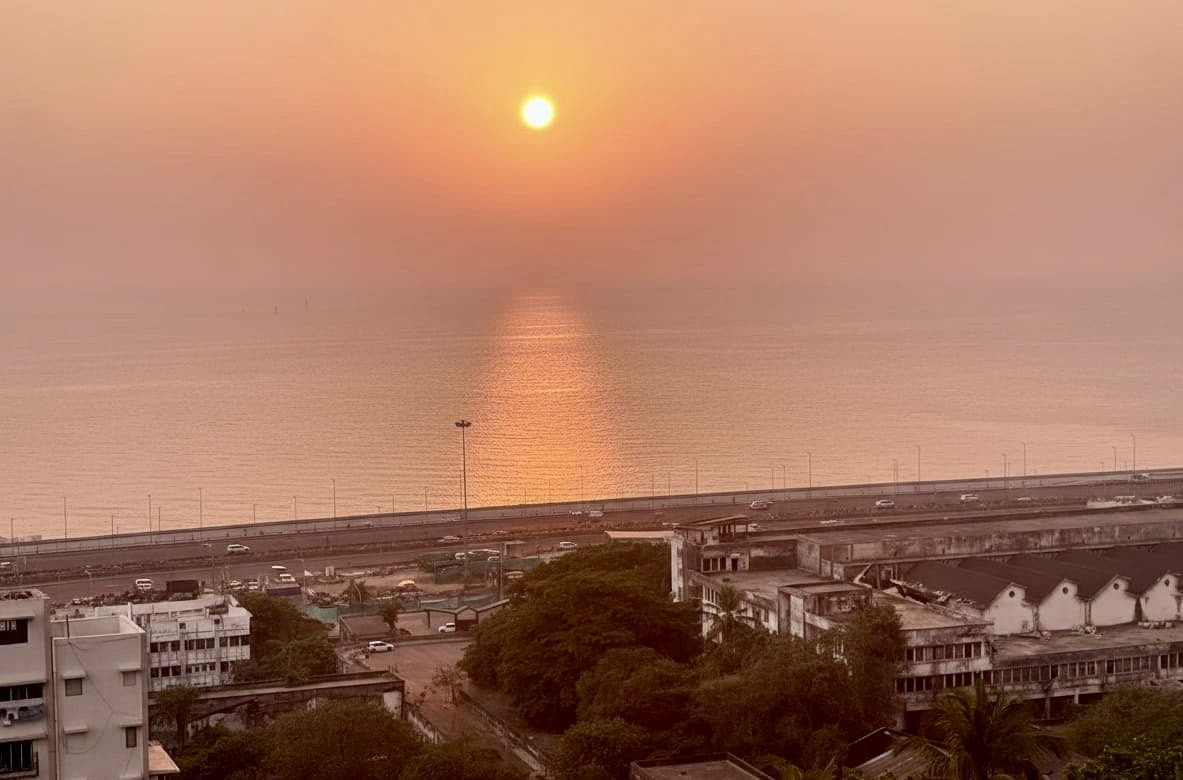
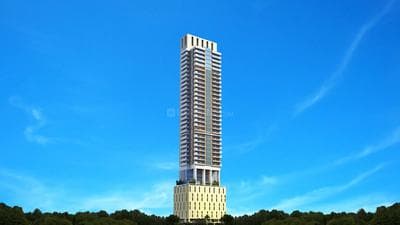
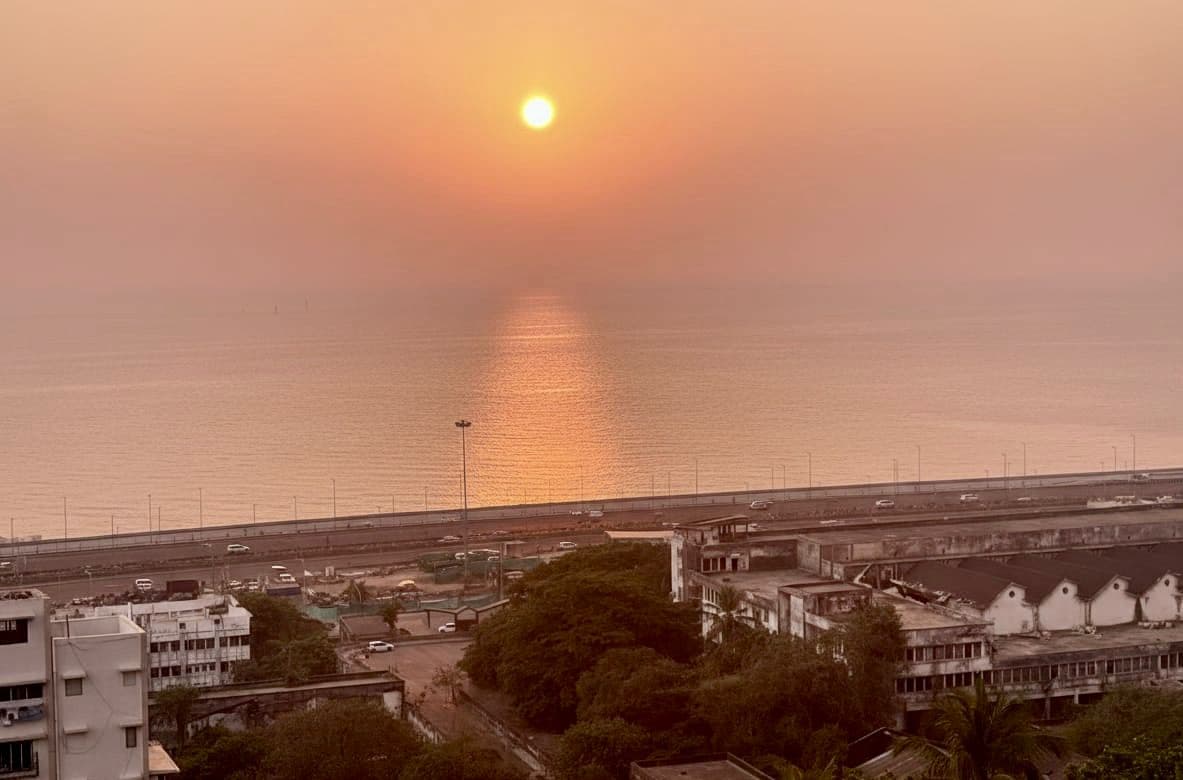
Worli Sea Face properties trade at a 27% PSF premium over the locality median — ₹85,000-1.2 lakh per sqft against the ₹68,950 Worli benchmark Property Butler tracks. That premium has historically been about the view, the air, and the unbroken horizon. The Coastal Road has now changed the shoreline hydrodynamics in ways that are not subtle — visible erosion patterns have shifted at the south end of the Sea Face, the wave-reflection geometry has changed at the rocky stretches, and the salt-spray profile on lower-floor façades has measurably intensified. For buyers writing ₹30-80 Cr cheques on sea-front towers, the climate-risk audit is no longer optional. This is the framework Property Butler now runs on every sea-face Worli offer.
Key Insight — May 2026
Of the 14 sea-front Worli towers Property Butler tracks, 9 were designed before the Coastal Road's shoreline-modification was finalised. The post-2022 hydrodynamic re-modelling shows seasonal high-tide reach is now 2.4-4.1 metres closer to building edges in three south-end Sea Face zones than it was a decade ago. Foundation depth, lower-floor waterproofing, and façade salt-resistance specifications written in 2014-2018 may not be adequate for the 2030-2050 horizon.
Five climate-risk vectors specific to Worli sea-front buildings
- Shoreline erosion / accretion rate. Post-Coastal-Road, the south end of Sea Face shows erosion; the north end shows accretion. Both affect building-foundation safety margins differently.
- Salt-spray intensity at façade. Property Butler's acoustic-environmental audit teams have measured a 14-22% increase in salt-spray reach on lower-floor façades of Worli Sea Face towers between 2018 and 2025.
- Storm-surge return period. The 100-year storm-surge return interval has compressed; the 100-year event now models closer to a 40-50 year recurrence.
- Sea-level rise to 2050. IPCC scenarios suggest 18-32 cm rise by 2050 at Mumbai latitudes. Most older Worli sea-front foundations were designed before this curve was internalised.
- Monsoon intensity / cyclone exposure. The increase in cyclone-tail effects reaching Mumbai (Tauktae 2021, Biparjoy 2023) is now a tail risk for wind-load engineering on tall sea-front towers.
The risk-tier mapping by sea-front sub-zone
| Sub-Zone | Erosion Pattern (2018-2025) | Climate-Resilience Risk Tier | Diligence Intensity Needed |
|---|---|---|---|
| North Sea Face (towards Haji Ali) | Mild accretion | Lower | Standard sea-front audit |
| Central Sea Face (Worli Sea Link end) | Near-stable, micro-variation | Moderate | Enhanced foundation review |
| South Sea Face (Worli Koliwada to Coastal Road junction) | Erosion 2.4-4.1m closer to edges | Elevated | Full climate-resilience deep dive |
| Worli Naka interior (1-2 km inland) | N/A (inland) | Negligible direct sea-risk | Storm-water drainage audit |
The climate-resilience audit Property Butler runs on sea-front offers
Before committing on a sea-front Worli tower, Property Butler's diligence team runs a six-line climate-resilience audit. The questions are precise; the answers should be in writing from the developer or the society.
- Foundation depth and design assumptions. What was the design ground-water table and what was the seismic + storm-surge combination used? For sea-front towers, foundation depth should be 2.5-3.5x the typical inland tower at the same height — verify with the structural drawings.
- Façade salt-resistance specifications. What is the salt-rated finishing on the external cladding, what is the joint-sealant cycle, and what is the projected maintenance interval? Standard façade specs that work inland degrade 35-55% faster on Worli sea-front.
- Lower-floor flood-protection. Basement parking water-ingress protection, ground-floor amenity area waterproofing, electrical-room positioning above maximum storm-surge level + 2 metre buffer.
- Wind-load engineering. Was the building designed for a 1-in-50-year cyclone-tail event or just the 1-in-25-year? Tall sea-front towers should target the higher resilience threshold.
- HVAC corrosion design. Sea-front buildings need stainless / coated HVAC components 3x more often than inland. What is the spec, what is the replacement cycle, and what is the projected lifecycle maintenance cost?
- Society sinking fund for climate-resilience capex. Has the society explicitly provisioned for façade re-finishing, foundation-waterproofing, and salt-rated equipment replacement cycles? Or is the sinking fund running on old assumptions?
Salt-Spray Reach on Worli Sea-Front Façades
+14-22% from 2018 baseline
Property Butler tracked environmental measurements, 2018-2025
Resilience-investment cost overlay
The climate-risk question becomes practical when translated into lifecycle maintenance cost. For a 3,200 sqft Worli sea-front 4 BHK, the resilience-driven maintenance differential over a 20-year hold-period is:
| Cost Category (20-year cumulative) | Sea-Front Tower | Inland Equivalent | Differential |
|---|---|---|---|
| Façade re-finishing | ₹35-55 L/unit | ₹12-22 L/unit | +₹23-33 L |
| HVAC corrosion replacements | ₹18-28 L/unit | ₹7-12 L/unit | +₹11-16 L |
| Foundation/basement waterproofing | ₹8-14 L/unit | ₹2-5 L/unit | +₹6-9 L |
| Window/glazing maintenance | ₹6-10 L/unit | ₹2-4 L/unit | +₹4-6 L |
| Insurance premium | ₹3-6 L/unit | ₹1-2 L/unit | +₹2-4 L |
Cumulative 20-year climate-resilience maintenance differential: ₹46-68 lakh per unit. On a ₹30 Cr trophy purchase that is 1.5-2.3% of property value — not catastrophic, but material enough to factor into the 20-year IRR calculation. The buildings that have explicitly provisioned for this in their sinking-fund design have a competitive advantage; those that have not will need to extract special levies from owners as the bills come due.
The view-durability question
The sea view is largely durable — the Coastal Road is a sea-fill, not a sea-block, and the view-line to the horizon is preserved. What can change over a 25-year horizon: (a) lower-floor view obstruction from any new coastal-road-edge built environment (cycling paths, kiosks, seasonal events infrastructure); (b) salt-rain on glazing reducing visual clarity if glass-coating maintenance is deferred; (c) any future shoreline-protection structures (sea-walls, accretion-management) that might rise at the building edge.
None of these is presently scheduled in any government plan that Property Butler is aware of, but they are within the realistic envelope of 25-year planning surprises. The view-durability angle is one Property Butler discusses with every sea-front buyer as part of the climate audit — it is not a deal-breaker but it is a known unknown.
Climate-resilient sea-front buyer markers
- Post-2020 design with cyclone-tail and SLR provisions
- Salt-rated cladding with documented maintenance schedule
- Society sinking fund modelled for climate capex
- Foundation depth 2.5-3.5x inland tower benchmark
- Lower-floor utilities above storm-surge + buffer
- Insurance coverage active and renewal cycle clean
Resilience warning signs
- Pre-2015 design, no post-Coastal-Road retrofit assessment
- Recurring water-ingress in basement / lobby
- Society discussing façade-repair levies in last 36 months
- HVAC running with frequent unplanned downtime
- No documented insurance coverage on building
- Sinking fund balance below 4x annual maintenance
The investment-time-horizon angle
For buyers with a holding horizon under 7 years, climate-risk is a tail factor — the immediate cashflow and capital-gains math dominate. For buyers writing the ₹30-80 Cr cheque as a multi-generational asset (which most ultra-luxury Worli sea-front buyers are), climate-risk becomes a first-order consideration. The differential maintenance cost over 25-50 years is material; the resilience-design quality of the building is essentially un-fixable post-purchase; the resale market in 2040-2050 will increasingly discriminate on climate-readiness.
Property Butler's recommendation for the inter-generational buyer: pay a 5-8% premium for a post-2020 designed sea-front tower over a pre-2015 designed equivalent at the same view band. The maintenance differential and the future-resale advantage will recover that premium within 12-18 years.
Frequently Asked Questions
Has the Coastal Road materially increased flood risk for Worli sea-front buildings?
The Coastal Road itself is engineered to reduce flood risk by absorbing wave energy and routing storm-water more efficiently. However, the shoreline-modification has redirected wave-reflection patterns at some south-end stretches in ways that mildly increase salt-spray reach on the lower façades of nearby buildings — not flood risk per se, but maintenance intensity. Property Butler's assessment is that net flood risk has not materially increased, but the maintenance-cost profile of pre-Coastal-Road designed buildings has shifted. The newer towers designed with the Coastal Road already in place have provisioned for this. See our Worli flood-monsoon vulnerability tower-elevation guide for the building-level assessment.
Should I pay the sea-front premium if my holding horizon is 5-7 years?
For a 5-7 year horizon, the sea-front premium is supported by the rental-yield differential (sea-front towers lease at a 18-28% premium to inland Worli equivalents) and by the better-than-average capital-appreciation pace on sea-front stock. Climate-risk concerns are secondary at this horizon — the differential maintenance costs compound over decades, not years. For 5-7 year horizons, the bigger questions are view-line preservation, view obstruction from any new sea-front construction, and the developer's track record. The full climate-audit becomes critical for 15+ year holds, multi-generational holds, or trust-owned assets.
How can I verify if a Worli sea-front tower's foundation is engineered for climate resilience?
Request the structural design documents from the developer (for under-construction towers) or from the society (for ready buildings). The critical pages: pile/foundation design report, ground-water table assumption, seismic + storm-surge load combination, façade wind-load specification, and the structural-engineer's certification. For older buildings, request the society's most recent structural-audit report (mandatory in Maharashtra for buildings over 30 years old). If the structural-audit report flags issues or the society has not commissioned one recently, that is a meaningful signal. Property Butler's diligence team includes structural review on every sea-front offer above ₹20 Cr.
Does buildings insurance in Worli adequately cover climate-related damages?
Standard buildings insurance in Worli typically covers fire, lightning, basic flood, and structural damage. Specialised endorsements are required for (a) salt-spray façade deterioration claims, (b) cyclone-tail wind damage above certain thresholds, (c) progressive water-ingress beyond a single event, and (d) consequential losses from utility failures during storm events. The premium differential for the enhanced sea-front-resilient cover runs 1.4-2.1x the standard policy. Owner-level top-up policies are also worth evaluating for high-value contents and interior finishes — the society's policy typically does not cover the inside of individual flats. See our Worli property insurance coverage guide.
Considering a Worli sea-front trophy purchase?
Property Butler runs the full climate-resilience audit on every sea-front Worli offer before token — structural review, façade-spec assessment, sinking-fund adequacy, and 20-year maintenance modelling in writing within 5 working days.
Browse Worli Sea-Front PropertiesRelated Reading
→ Worli Seafront Corrosion & Maintenance Lifecycle Cost → Worli Flood-Monsoon Vulnerability & Tower Elevation → Worli Sea-View Future-Proofing — Which Towers Keep Their View → Worli Post-Coastal-Road Absorption & Pricing Impact → Worli Property Insurance Luxury Apartment Coverage → Worli Area Guide