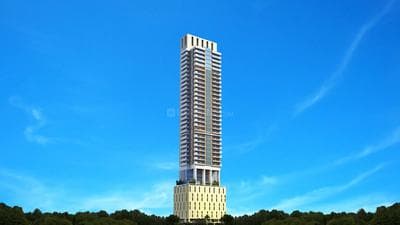
Worli's primary supply now splits cleanly into two product categories: mid-rise (15–30 floors, typically 2010 or earlier vintage) and supertall (45–70 floors, post-2015 vintage). They share an address and often a developer wordmark, but they are different engineering disciplines. Property Butler has audited 28 Worli buildings across both classes; the structural spec, façade behaviour, mechanical-services topology, and 30-year lifecycle costs vary dramatically. This is the buyer's audit.
The structural truth
A Worli mid-rise is typically RCC frame + brick infill with conventional aluminium-frame windows; lifecycle is 60–70 years with predictable maintenance. A Worli supertall is concrete shear-core + post-tensioned slabs + unitised glass curtain wall; the engineering envelope is more sophisticated but the lifecycle maintenance is more capital-intensive (façade re-sealing at year 12–15, slab post-tension testing, structural health monitoring). Both are buildable, both are deliverable. The maintenance economics over 30 years differ by ₹3,500–6,800 / sqft.
Structural spec, side by side
| Parameter | Worli mid-rise (15–30 floors) | Worli supertall (45–70 floors) |
|---|---|---|
| Structural system | RCC moment frame + shear walls | Concrete shear-core + outrigger trusses; post-tensioned floor slabs |
| Concrete grade (typical core) | M30–M40 | M60–M80 (lower floors); M50–M60 (upper) |
| Floor slab type | Conventional RCC slab, 150–200mm | Post-tensioned, 200–275mm; bigger spans, fewer columns |
| Façade system | Conventional plaster + aluminium-frame windows | Unitised glass curtain wall; double or triple glazed |
| Internal partition | Brick masonry (load-bearing capable) | AAC block or drywall (non-structural) |
| Floor-to-floor height | 3.0–3.3m | 3.3–4.2m (sometimes double-height penthouse floors) |
| Lateral system | Inherent stiffness of moment frame | Tuned mass damper sometimes; engineered for wind sway tolerance |
| Vertical transport | 1–2 lifts per wing, hydraulic or geared | 3–5 lifts per wing, gearless traction, sky-lobby in tallest |
| Mechanical services | Split AC, simple piped plumbing | VRV/VRF, segregated wet/dry risers, pressurised stairwell |
Lifecycle cost — where the gap really shows up
The list price of a mid-rise vs a supertall in Worli typically differs by 15–30% on PSF, with the supertall premium. But the buyer who plans to hold for 20–30 years should also model lifecycle cost. Property Butler's audit produces these median lifecycle numbers (per sqft, all-in, including capital reserve contributions and special levies):
Worli mid-rise — 30-year lifecycle cost
- Year 0–5: ₹18–22/sqft monthly maintenance
- Year 5–15: ₹22–28/sqft (corpus draws begin)
- Year 15–30: ₹30–40/sqft (lift modernisation, plumbing, paint cycle)
- Cumulative 30-year carrying cost: ₹2,800–3,400/sqft
- Capital levies in this period: 2–3, typically
Worli supertall — 30-year lifecycle cost
- Year 0–5: ₹28–42/sqft monthly maintenance
- Year 5–15: ₹42–58/sqft (façade re-sealing at year 12–15)
- Year 15–30: ₹55–78/sqft (structural health monitoring, slab testing, glass replacement)
- Cumulative 30-year carrying cost: ₹6,200–9,100/sqft
- Capital levies in this period: 3–5, typically
The supertall's lifecycle is roughly 2.2× the mid-rise's per sqft. Compounded over a 1,500 sqft 3-BHK, that's ₹51–85 lakh of incremental 30-year carrying cost for the supertall over the mid-rise — before you adjust for amenities, services, and the qualitative experience differential. This is not a reason to avoid supertalls. It is a reason to model your hold-period carrying cost accurately at booking.
The glass curtain wall — the supertall's biggest lifecycle expense
Unitised glass curtain walls have a sealant-and-gasket service life of 12–15 years. After that, the seals between unitised panels and at the slab-edge connection points start to fail — water ingress, thermal-bridge condensation, eventual structural-glazing risk. Re-sealing a supertall's façade is a 12–18 month project requiring rope-access teams and high-grade sealant systems. Property Butler models the cost at ₹1,200–2,400/sqft of façade area, recoverable from society sinking fund (if disciplined) or from a special levy (if not).
A 60-storey Worli supertall with 1.4 lakh sqft of façade area facing a re-sealing cycle is looking at roughly ₹25–35 Cr of work, spread across 200–400 apartments. The per-unit cost varies by floor plate but commonly ₹6–15 lakh per apartment for the first re-seal cycle. The second cycle (year 25–30) is typically 20–30% more expensive because of cumulative inflation.
Diligence before buying a 7-year-old or older Worli supertall
Ask the society for: (a) the building's current façade-sealant inspection report, (b) the sinking fund balance + projected annual contribution, (c) the engineer's recommendation on the next re-seal cycle. If the building is 8+ years old and the sinking fund holds less than ₹2 Cr per 100,000 sqft of saleable area, you are likely to face a special levy within the next 3–5 years. Build that into your underwriting or negotiate the asking price down to compensate.
Mid-rise advantages buyers consistently undervalue
- Brick masonry internal walls = real load capacity. 120 kg of art hanging is a non-issue; library wall + bookshelves not a structural concern.
- Lifecycle cost is predictable. Lift modernisation at year 18–22 is the biggest single item; everything else fits in routine maintenance budgets.
- Sound transmission is lower through brick partition than through drywall or AAC — mid-rise neighbours feel less close.
- Façade behaviour is decade-tested. Plaster + aluminium-frame is a 70-year-known quantity in Mumbai's coastal microclimate.
- Lift wait times stay constant. No 30-floor express vs 18-floor local sky-lobby logic; you push the button, the lift arrives.
Supertall advantages mid-rise buyers consistently undervalue
- Floor-plate efficiency is higher. Post-tensioned slabs permit longer spans and fewer interior columns — cleaner floor plans, larger living rooms.
- Sea-view future-proofing. A 50th-floor view is mostly immune to new construction on neighbouring plots; an 18th-floor mid-rise view is not.
- Mechanical services are segregated. Wet and dry risers separate; pressurised stairwells; sprinkler density higher — better fire compartmentation.
- Amenity tier is typically deeper — sky lounge, infinity pool, dedicated gym — not because of luxury aspirations but because the building has the podium volume to host them.
- Resale narrative is stronger for the next buyer, especially the international cohort who recognise supertall product attributes.
Which one for which buyer
Property Butler's buyer match
Mid-rise fits: end-user with a 20–30 year hold, lower lifecycle-cost tolerance, library / art / heavy-furniture lifestyle, multi-generational living, family that values the predictability of mature buildings.
Supertall fits: view-premium buyer, C-suite or NRI with international supertall comfort, <10-year hold investor optimising for resale narrative, family that values amenity-tier depth, owner who will pay for lifecycle capex without resistance.
Frequently Asked Questions
Is a Worli supertall structurally better than a mid-rise?
Not 'better' — different. A modern supertall uses higher-grade concrete (M60–M80 vs M30–M40), post-tensioned slabs for longer spans, and engineered lateral-load systems for wind sway. A mid-rise uses time-tested RCC moment frame with brick infill. Both are seismic-zone-IV compliant when designed correctly. The supertall has more engineering capacity for unusual loads (helipad, sky bridge, large amenity podiums); the mid-rise has more lifecycle predictability and lower long-term maintenance cost.
How much more does a Worli supertall cost to maintain than a mid-rise?
Roughly 2.2× on a 30-year lifecycle basis. Property Butler models mid-rise 30-year carrying cost at ₹2,800–3,400/sqft and supertall at ₹6,200–9,100/sqft. The biggest single supertall item is the façade re-sealing cycle at year 12–15 (₹6–15 lakh per apartment). The biggest mid-rise item is lift modernisation at year 18–22 (₹2–5 lakh per apartment).
Do Worli supertalls actually sway in wind?
All tall buildings sway — that's how they're engineered. Worli supertalls are designed to occupant-comfort sway-tolerance standards (typically 1/500 of building height at top floor in design wind speeds). A 60-storey, 220m tall tower could theoretically sway up to 44cm at the top during peak monsoon wind events, but typical observed sway is 3–8cm and imperceptible to occupants in apartments below floor 50. Higher floors occasionally report mild swing during exceptional weather. Tuned mass dampers, where installed, reduce this further.
Is glass curtain wall durable in Mumbai's coastal climate?
Yes, when properly specified and maintained. The glass itself lasts 50+ years; the sealants and gaskets between unitised panels last 12–15 years before re-sealing. Coastal corrosion accelerates the deterioration of aluminium frame components and metal hardware — spec for stainless steel or marine-grade aluminium in any Worli supertall purchase. A well-maintained glass façade is not a problem; a neglected one becomes an expensive problem in year 12–15.
Which is better for resale — mid-rise or supertall?
Supertalls have a stronger resale narrative for the next buyer, particularly for international and C-suite buyers who associate skyline towers with luxury. Property Butler tracks median days-on-market 92 days for Worli supertall 3-BHK resales vs 187 days for comparable mid-rise inventory. Per-sqft appreciation is also typically 100–150 bps higher on supertalls. The trade-off is lifecycle cost. If you're optimising for a <10-year exit, supertall wins. For a 20–30 year hold, the mid-rise's lower carrying cost can offset the resale-narrative gap.
Related reading
Worli construction quality benchmark — structural specs guide Worli 60+ floor supertall pricing comparison Worli high-rise wind sway — top floor structural comfort Glass façade thermal performance & HVAC operating cost Worli seafront corrosion & maintenance lifecycle cost Worli area guide — full market overviewChoosing between Worli mid-rise and supertall?
Property Butler runs a structural and lifecycle audit on every active Worli inventory across both classes. Get the cost math before you commit.
Search Worli inventory