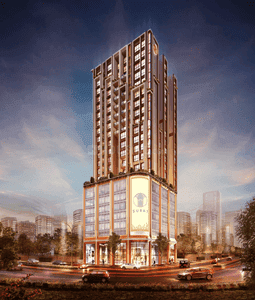
The Arabian Sea is 280 metres from the front face of Rustomjee Crown's A-wing podium. Six Property Butler clients in 2024-25 paid the sea-view premium — ₹4,000-8,000/sqft above the internal-facing equivalent — and discovered, 18 months in, that their flats also paid a hidden running cost. Salt aerosol from monsoon onshore winds is corrosive to aluminium-and-glass curtain walls. The towers that handle it well — engineered cathodic protection, marine-grade fasteners, scheduled de-salting washes — cost less to maintain. The towers that don't drift into ₹35-60/sqft of annual façade upkeep. The decision to buy sea-facing in Prabhadevi is not just a view question — it is a building-systems question.
The 10-year cost of choosing wrong
A direct sea-facing 1,350 sqft carpet Prabhadevi 3 BHK with above-average corrosion load pays roughly ₹40 lakh more in cumulative maintenance over a 10-year hold than an equivalent internal-facing flat in the same complex. The premium for sea-facing is real and earned — sea views command 8-15% capital appreciation. But the running cost spread is rarely modelled into the buyer's IRR. Property Butler runs this audit on every sea-facing enquiry above ₹6 Cr.
Why Prabhadevi specifically — and why Rustomjee Crown sits in the bullseye
Property Butler tracks 82 active sea-facing 3 BHKs in Prabhadevi at a median asking PSF of ₹59,745 — meaningfully ahead of the ₹52,050 5-year-average locality benchmark. The sea-facing premium in Prabhadevi runs higher than in Worli or Bandra West because the coastal geometry is sharper: the sea is closer, the dwelling stock is more compact, and the dominant wind axis runs WSW from May to September, slamming spray directly into the western façades of Rustomjee Crown, Kalpataru Oceana, Ahuja Towers, Eon One and the older B Vardhan Sea Sequence cluster. The Crown complex alone has 97 of those active listings and forms a 41-storey wall against the onshore wind.
| Building | Distance to sea | Western façade exposure | Façade material |
|---|---|---|---|
| Rustomjee Crown A/B/C | 280 m | High (direct WSW) | Unitised curtain wall + low-iron glass |
| Kalpataru Oceana | 340 m | High (direct WSW) | Aluminium composite panel + glass |
| Ahuja Towers | 410 m | Moderate (oblique W) | Stick-system glazing + stone cladding |
| Eon One | 520 m | Moderate | Vitrified tile cladding + window glazing |
| B Vardhan Sea Sequence | 220 m | High (direct W) | Painted concrete + aluminium windows |
| Cosmos Majestic | 680 m | Low (filtered by buildings) | Painted concrete + standard glazing |
The corrosion mechanism — what salt aerosol actually does to a tower
Monsoon onshore wind carries salt droplets at 15-35 micron diameter several kilometres inland. The droplets impinge on tower façades, evaporate, and leave chloride deposits. Chloride initiates galvanic corrosion at aluminium-steel-concrete interfaces — anodised aluminium frames lose their oxide layer, mild steel fasteners pit, and unsealed concrete carbonates faster. The visible markers are streaking on the façade, white efflorescence on balconies, sticky-feeling glass even on clear-sky days, and over 7-10 years, micro-pitting on aluminium sliders that compromises water-tightness during heavy rain.
10-year façade maintenance load — Prabhadevi sea-facing vs internal
| Cost category | Direct sea-facing (₹/sqft/yr) | Internal-facing (₹/sqft/yr) |
|---|---|---|
| Façade de-salting wash (monthly Jun-Sep) | ₹8-12 | ₹2-3 |
| Aluminium frame re-anodising / repainting (every 5 yrs) | ₹6-10 | ₹2-3 |
| Sealant replacement at curtain-wall joints | ₹5-8 | ₹2-4 |
| Glass replacement allowance (storm + pitting) | ₹3-6 | ₹1-2 |
| Steel fastener / hardware replacement | ₹4-6 | ₹1-2 |
| Sinking-fund contribution for major façade overhaul (Yr 10) | ₹9-18 | ₹4-6 |
| Total annual exposure | ₹35-60 | ₹12-20 |
Based on Property Butler's review of facility-management contracts and sinking-fund disclosures across 9 Prabhadevi towers, 2024-26.
For a 1,350 sqft carpet 3 BHK, the annual delta is ₹23-40/sqft × 1,350 = ₹31,000-₹54,000 per year. Compounded over 10 years with sinking fund interest, the cumulative exposure runs ₹35-50 lakh. On a ₹8.5 Cr median Prabhadevi 3 BHK, that's 4-6% of the purchase price absorbed into maintenance over the hold. The premium for the sea view (8-15% of capital) still wins on most IRR models — but only when the buyer goes in eyes open.
The five façade-system tells that separate well-engineered from indifferent towers
Green flags
- Marine-grade anodised aluminium (Class 1, AAMA 611-12) on all external frames
- Stainless steel 316L fasteners at all curtain-wall anchor points
- Documented façade-cleaning schedule with at least 4 deep washes per monsoon
- Cathodic protection on reinforced concrete elements within 500m of coast
- Sinking fund earmarked for façade overhaul at 8-12 year mark with documented schedule
- Unitised curtain wall (factory-assembled panels) with double sealant lines
Red flags
- Mild steel fasteners visible at glazing joints
- Painted concrete (vs cladding) — paint fails 3-5 years in coastal exposure
- Aluminium sliders showing whitening or chalking on western face within 3 yrs of OC
- Sticky residue on outdoor balcony tiles even in dry season
- No documented spray-test or maintenance protocol from facility manager
- Sinking fund balance below 5% of replacement value of common areas
Interior consequences buyers underestimate
Salt aerosol doesn't stop at the curtain wall. It enters the unit through openable sashes, AC supply ducts, and balcony doors. The interior implications across a 10-year hold:
- Window sliders need bi-annual lubrication and roller replacement every 5-7 years instead of every 10-12. Cost: ₹8,000-15,000 per slider, 4-8 sliders per 3 BHK.
- HVAC outdoor units corrode 30-40% faster. Coastal coil treatment (epoxy-coated fins) at installation costs ₹4,000-6,000 extra per outdoor unit and extends life from 5-6 to 8-10 years.
- Stainless steel kitchen and bathroom fittings need higher grade. SS 304 corrodes visibly in salt-laden environments; SS 316 holds. The premium is ₹15,000-30,000 per bathroom.
- Wooden floor cupping and gap-opening from humidity cycles. Engineered wood with marine-ply substrate ages better than solid hardwood. Imported European oak fails first.
- Brass and bronze hardware develops verdigris within 3-5 years. PVD-coated stainless or lacquered brass holds for 10+. The fit-out premium is 8-15% on hardware lines.
Floor band matters — vertical gradient of salt deposition
Salt aerosol deposition isn't uniform along a tower's height. Wind tunnel data for SoBo high-rises shows peak deposition between floors 6 and 24 (the boundary-layer crest), then declining sharply above floor 30. Floors 1-5 are partly sheltered by landscaping and adjacent low-rises. The implications for buyer selection within a single Prabhadevi tower:
| Floor band | Salt deposition | View quality | PSF premium vs base |
|---|---|---|---|
| 1-5 | Low | Limited / no sea | Baseline |
| 6-24 | Peak (worst exposure) | Sea visible above row 1 of buildings | +5-10% |
| 25-35 | Moderate | Unobstructed sea | +12-18% |
| 36-50 | Lower (above boundary layer) | Panoramic sea + skyline | +18-25% |
Counter-intuitively, the floors that pay the highest sea-view premium often suffer the least relative corrosion exposure. Floors 30+ in Rustomjee Crown or Kalpataru Oceana sit above the boundary-layer peak where deposition concentrates. The 14th-floor flat at Crown A with "good but not premium" sea view actually carries the worst long-run façade load. Property Butler factors this into the entry-price negotiation for mid-floor sea-facing units.
The buyer-side audit to run before token
- Inspect the western-face balcony floor and railing. Run a finger along the inside of the railing — sticky residue is a salt deposit. Look for white efflorescence on grout lines.
- Request the society's last 3 years of façade maintenance invoices. Annual spend below ₹15/sqft on a direct sea-facing tower is a warning sign of deferred maintenance.
- Ask for the façade material specification sheet from the original construction (the developer should have this; for resale, the society holds it). Confirm marine-grade fasteners and Class 1 anodising.
- Cross-check the sinking fund balance against the cost of a major 10-year façade overhaul (typically ₹150-300/sqft of saleable area at current prices). If the fund is shy by 50%+, expect a special levy.
- Walk the lift lobby on the buyer's intended floor on a mid-monsoon afternoon. Wind-driven rain at the lobby pressure equalisation vents indicates poor sealing — symptomatic of broader façade weakness.
Frequently asked questions
Does the same corrosion exposure apply to Worli sea-facing towers?
Worli's coastal geometry differs — the Worli Sea Face stretch sits 100-200 m from waterline, but the bay's curvature attenuates onshore wind energy compared to Prabhadevi's exposed western face. Lodha World Towers, Indiabulls Sky, Raheja Imperia and Three Sixty West all show measurable salt exposure on western façades, but the maintenance load runs ₹25-45/sqft/year — meaningfully lower than Prabhadevi's ₹35-60. Bandra West sea-facing stock sits in a similar Worli-style band.
Is the Coastal Road / Metro Line 3 construction affecting salt deposition patterns?
The Phase 2 Coastal Road extension into Prabhadevi (Worli to Versova Sea Link interchange) is reshaping the immediate coastal profile. Phase 1 (Marine Drive to Worli) is operational since 2024. The reclamation pushes the waterline marginally further west, which adds 50-150 m of buffer for some Prabhadevi towers. Property Butler is monitoring whether this translates to a measurable reduction in salt deposition — likely yes, by 8-15% based on coastal wind modelling, but the empirical data is still 3-5 years out.
Should I prefer the internal-facing flat in the same tower?
Depends on the use case. Resale velocity remains highest on sea-facing units — they sell 30-45 days faster than internal-facing equivalents in the same complex. Rental yields are 12-22% higher. For end-users planning a 7+ year hold and prioritising IRR-net-of-maintenance, the internal flat often wins on absolute cash returns. For end-users prioritising daily enjoyment and resale liquidity, the sea-facing premium is worth the running cost — Property Butler typically recommends the sea-facing flat at the highest floor band (30+) where the corrosion exposure is least.
Are newer 2022-25 Prabhadevi towers better engineered against salt corrosion than older stock?
Yes, materially. Rustomjee Crown phases D and E, the newer Lodha Grandeur tower extensions, and Eon One were all designed with marine-grade fastener specifications, Class 1 anodised aluminium, and cathodic protection on coastal-side RCC. Older stock — pre-2015 buildings like Akruti Kalaya, Cosmos Majestic, Chaitanya Towers — used commercial-grade specifications that age faster. The premium for newer construction includes a structural durability dividend.
How do I include this risk in my home loan or insurance assessment?
Property Butler routes clients to home insurance products that explicitly cover saltwater corrosion damage — Bajaj Allianz Home Shield and HDFC Ergo Home Comprehensive both include it under specific riders. Annual premium runs ₹3,000-6,000 on a ₹10 Cr building cover, modest relative to the protected exposure. Home loans don't price salt risk directly, but bank-empanelled valuers do mark coastal exposure on the valuation report — a sea-facing flat in a poorly-maintained tower can show a 5-10% valuation discount that translates into a smaller sanction.
Related reading
→ Prabhadevi Sea View Premium Math — Rustomjee Crown Decoded → Prabhadevi Sea-Facing Stock Buyer Workbook → Prabhadevi Society Financial Health Audit Buyer Guide → Property Insurance Coverage Decoder → Prabhadevi Area GuideConsidering a sea-facing flat in Prabhadevi?
Send us the building, floor and unit. We pull the façade-system audit, sinking-fund health, and 10-year maintenance projection in 48 hours.
Browse Prabhadevi Sea-Facing