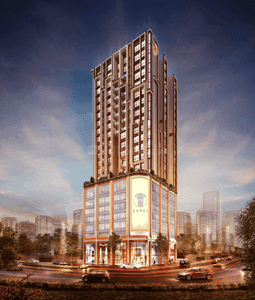
An older 2 BHK in a Prabhadevi society headed for cluster redevelopment trades at roughly 50-60% of the all-in cost of an equivalent ready 3 BHK at Rustomjee Crown or Kalpataru Oceana — for the same likely end-state product 3-5 years out. The math is structurally interesting: you are paying for the land share + transit period rent + builder execution risk, in exchange for an end-state new flat at a cost basis materially below today’s asking. Property Butler has tracked nine completed Prabhadevi-corridor redevelopments and 14 active cluster pipelines — here is the playbook for buying into them as a deliberate strategy.
This is not the same as buying a flat for self-occupy and accepting redevelopment as a side outcome. This is buying with redevelopment as the explicit thesis — a 3-5 year hold engineered to convert a 1980s-90s 800 sqft carpet 2 BHK into a 1,200-1,500 sqft new-tower 3 BHK at completion. The risk-adjusted return on this strategy, when executed correctly, runs 14-22% per annum versus the 6-9% on direct ready-stock buying.
- Active redevelopment pipelines tracked: 14
- Stage-2-or-later (post-NOC, builder shortlisted): 6
- Stage-4 (RERA registered, demolition imminent): 2
- Median asking, redev-bound 2 BHK: ₹3.4-4.8 Cr
- Equivalent ready Crown 3 BHK ask: ₹8-10 Cr
- Typical new-flat allotment: 1.4-1.8x existing carpet area
- Construction timeline median: 36-48 months (post-IOD)
- Transit rent typical: ₹1.2-1.8 lakh / month paid by builder
The Seven-Stage Redevelopment Pipeline — Where to Buy
Every redevelopment moves through seven gating stages. Each stage clears specific risk and re-rates the asset price. Property Butler maps where on the curve a buyer should enter for which return profile.
| Stage | Milestone | Asset re-rate | Buyer profile |
|---|---|---|---|
| 1 | Initial society resolution to redevelop | +5-8% | Aggressive value-buyer |
| 2 | Builder shortlist + 70% society approval | +12-18% | Calibrated buyer |
| 3 | Development agreement signed + IOD application | +10-15% | Mid-risk buyer |
| 4 | RERA registration + IOD obtained | +8-12% | Conservative buyer |
| 5 | Demolition + transit rent commences | +5-8% | Risk-off buyer |
| 6 | Construction at 50% (slab cast) | +8-12% | Post-construction-risk buyer |
| 7 | OC obtained + new flat handover | +15-20% | End-user |
The cumulative re-rate from stage 1 to stage 7 typically runs 70-100% of acquisition basis — but most of that uplift accrues in the first three stages. Property Butler’s view: stage 2 (post-builder-shortlist + 70% approval) is the optimal entry point for a buyer with 4-6 year hold capacity. Earlier stages (1) carry meaningful project-cancellation risk; later stages (4+) compress the upside while the residual execution risk persists.
The Cost Stack — What You Actually Pay
Worked Example: Redev Buy-In vs Ready-Stock Comparison
Scenario A — Ready Crown 3 BHK acquisition:
- Asking price: ₹9.5 Cr (1,300 sqft, sea-facing, mid-floor)
- Stamp duty + GST: ₹66 lakh
- Brokerage + legal: ₹15 lakh
- All-in: ₹10.31 Cr; possession: immediate
Scenario B — Stage-2 redev 2 BHK buy-in:
- Acquisition price (existing 800 sqft 2 BHK in society at stage 2): ₹4.2 Cr
- Stamp duty + GST: ₹29 lakh
- Legal + due diligence + brokerage: ₹12 lakh
- All-in to acquisition: ₹4.61 Cr
- Transit rent during construction (typically builder-paid): ₹0 to buyer
- Carrying cost (interest on capital, opportunity cost): ~₹65-90 lakh over 4 years
- Final new-flat allotted: 1,200-1,400 sqft 3 BHK new construction (1.5x ratio typical)
- Post-completion market value of allotted flat: ₹8-9 Cr (today’s comparable Crown / Oceana adjacent)
- Effective acquisition cost: ₹4.61 Cr for ₹8-9 Cr asset 4 years out
Implied IRR (assuming current pricing holds, end-state ₹8.5 Cr, 4 years): ~17% per annum gross. Risk-adjusted (probability-weighted for delay / cancellation): ~12-14% per annum. The strategy beats direct-buy ready-stock on a risk-adjusted basis by roughly 5-7 percentage points per annum.
The Four Risks That Have Stalled Past Prabhadevi Redevelopments
Risk 1 — Society dissident block
Maharashtra Cooperative Societies Act requires 70% approval. A 30%+ dissident block can stall a project indefinitely through court action. Property Butler has tracked three Prabhadevi corridor projects locked at stage 2 for 3-5 years on this single risk.
Risk 2 — Builder default mid-construction
Tier 2-3 builders occasionally run out of project liquidity at slab-cast stage. Society then needs to terminate the development agreement and re-bid — adds 18-30 months. Tier 1 (Rustomjee, Lodha, Kalpataru, Mahindra) have lower default rates — pay the brand premium at builder shortlist.
Risk 3 — FSI / TDR misjudgement
If the project economics depend on aggressive FSI or TDR loadings that BMC subsequently disallows, the new-flat allotment ratio can compress from 1.5x to 1.2x (or worse). Validate the development agreement’s assumed FSI envelope versus current BMC norms before signing.
Risk 4 — Transit rent default
Builders sometimes fall behind on monthly transit rent during the 36-48 month construction window. Society members end up funding their own rent. Insist on a rent escrow / corpus structure where the builder pre-funds 18-24 months of transit rent. Maharashtra RERA mandates partial corpus but enforcement varies.
The Nine-Item Pre-Buy Checklist
Diligence Checklist Before Signing a Redev Buy-In
- Society NOC and 70%+ written approval — obtain certified copy
- Development agreement with builder — new-flat allotment ratio, free-sale ratio, transit rent terms
- Builder credentials — previous redev projects completed, OC ratio, RERA compliance history
- IOD status (if applied) — BMC application ID, any stop-work orders
- RERA registration number — verify on Maharashtra RERA portal
- Title deed chain — existing 2 BHK title clear back 30 years, no encumbrances
- Society conveyance status — whether building is on freehold or leasehold land, conveyance deed if any
- Transit rent corpus / escrow — written agreement on builder funding schedule
- Any pending litigation — civil suits, society arbitration, dissident challenges
Frequently Asked Questions
How do I find redevelopment-bound societies in Prabhadevi?
Property Butler maintains a tracked pipeline of every Prabhadevi society currently progressing through any of the seven redevelopment stages. The full list is internal but covers 14 active pipelines as of May 2026. The general filter for buyers screening publicly-listed inventory: pre-2000 buildings with floors below 12, on plots above 1,800 sqm, with society age above 35 years. Prabhadevi society redevelopment pipeline tracker.
What is the typical new-flat allotment ratio in Prabhadevi redevelopments?
Property Butler tracks a median 1.4x-1.6x ratio (existing 800 sqft 2 BHK gets allotted 1,200-1,300 sqft new flat). Higher ratios (1.7-2.0x) appear on plots with larger TDR loadings or in projects led by tier-1 developers willing to absorb a thinner free-sale margin. Ratios below 1.3x typically indicate marginal project economics — either a dense plot with limited FSI upside, or a thin builder margin. Ask explicitly for the allotment ratio before paying entry premium.
Can I sell the redevelopment-bound flat before construction completes?
Yes — the asset is freely transferable at every stage. Property Butler tracks active resale at stages 2, 3 and 4 in the corridor, with each stage adding a re-rate as outlined above. The buyer pool narrows post-stage-3 as more buyers become wary of timeline risk; stage-2 (post-builder-shortlist + 70% approval) is the deepest secondary-market liquidity window. Plan for 90-150 days median resale window if you need to exit pre-completion.
Is redevelopment buy-in better than new-launch under-construction?
Different risk profiles. New-launch under-construction in Prabhadevi (e.g. forthcoming Lodha or Kalpataru launches) carries pure construction-and-delivery risk — no society politics. Pricing is typically 20-30% below ready stock, with a 36-48 month possession runway. Redevelopment buy-in carries society-politics risk in addition to construction risk — but pricing is 50-60% below ready stock at stage 2 entry. The redev path delivers materially higher returns when execution succeeds; the under-construction path is the safer and more liquid option. Sophisticated buyers often hold both. Under-construction Lower Parel options.
What tax treatment applies to a redevelopment-bound flat?
The acquisition is treated like any flat purchase — full stamp duty (5% Maharashtra) and GST if the seller is a builder. The redevelopment swap itself (existing flat exchanged for new flat) is currently treated as a non-taxable exchange for the original-owner society member, but a fresh buyer who has bought into the society pre-redevelopment may face capital-gains computation issues if they sell post-completion and hold under 24 months. Always validate with a real-estate-specialist CA before signing — the tax classification has been the subject of multiple ITAT cases. Real buyer cost: stamp duty & GST decoder.
Identify a Prabhadevi Redevelopment Worth Buying Into
Property Butler audits the 14 active redevelopment pipelines in the corridor — stage, builder credentials, allotment ratio, transit rent structure. We surface only the ones worth buying into.
Explore Prabhadevi Older-Society StockOr WhatsApp +91 84335 11885