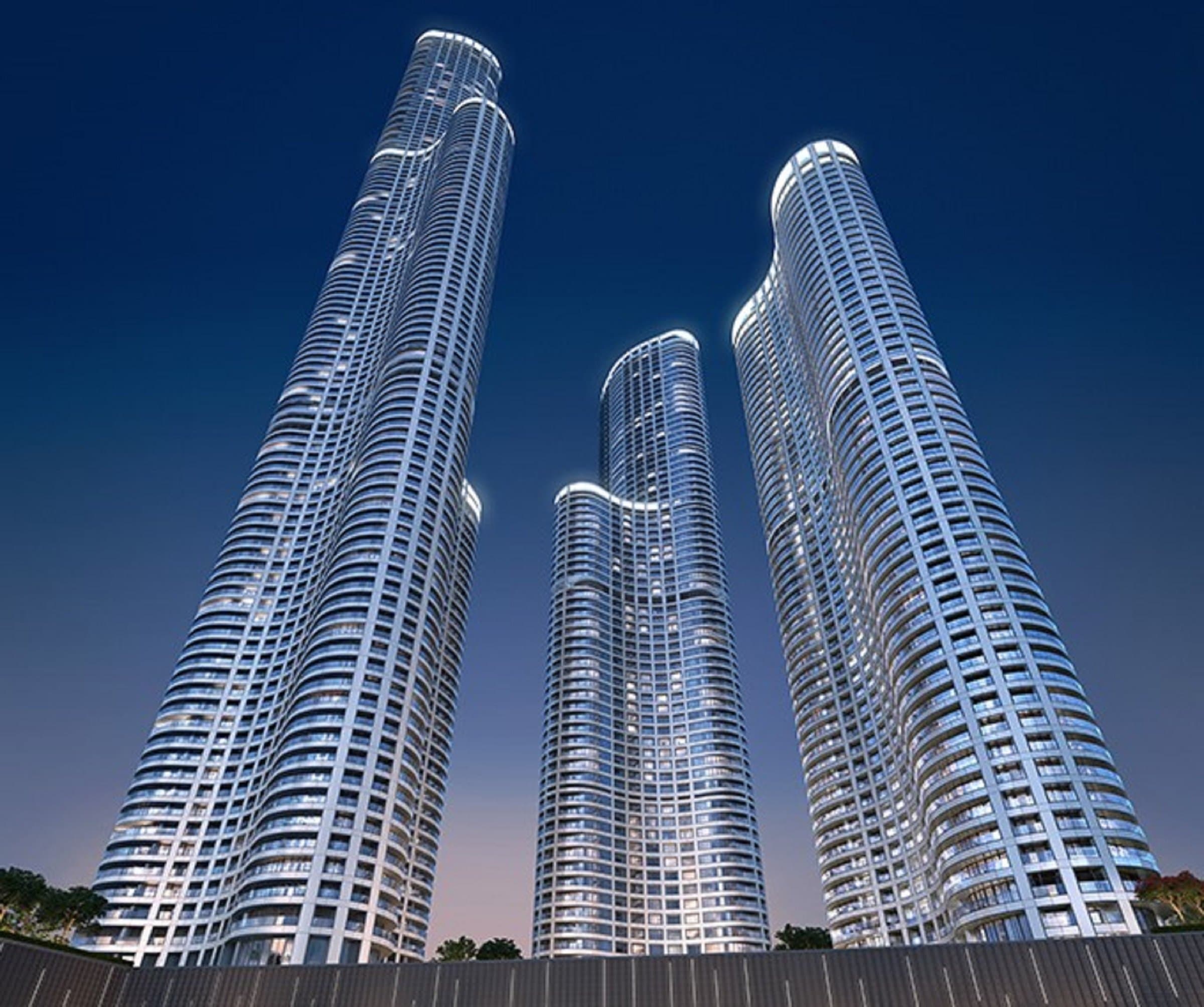
A handful of Lower Parel and Prabhadevi developments are structured as connected-tower clusters — multiple towers sharing a podium, an amenity slab, and often a high-altitude sky bridge or sky deck. The Indiabulls Sky Forest cluster in Lower Parel (towers A1 through A6 sharing podium and bridge), the Lodha World Towers complex (World One + World Crest + World View), and the Rustomjee Crown cluster in Prabhadevi (towers A, B, C with shared amenities and partial bridge connectivity) are the headline examples. From the outside they look like one project. Inside the pricing book they trade like 3-6 distinct micro-products, with PSF differentials of 8-19% between the best and the worst wing.
The economic logic is subtle. Cluster developments distribute amenity costs across more units, which structurally lowers the per-unit maintenance burden by 12-22% vs comparable stand-alone towers. They also create privacy and view trade-offs that the average buyer under-models. Property Butler treats every connected-tower cluster purchase as a wing-stack-floor selection problem, not a building selection problem.
The cluster premium — when it works, when it doesn't
Connected-tower clusters command a 4-9% PSF premium over comparable stand-alone luxury towers of the same vintage and locale. The premium is justified for buyers who use the amenity slab heavily (gym, pool, kids' play, club lounge, indoor sports). It is over-paid for buyers who rarely use amenities and would pay less for the same view and carpet in a stand-alone tower. The cluster also imposes inter-tower visual exposure on units facing the inner courtyard — Property Butler discounts these by 6-11% off the cluster's headline PSF.
The three Lower Parel + Prabhadevi cluster archetypes
Archetype A: Concentric podium cluster (Indiabulls Sky Forest)
6 towers (A1, A2, A3, A4, A5, A6) sharing a 3-level podium with amenity slab. Towers are arranged in a roughly hexagonal layout. Each tower has a different view profile: outer-facing units look outward (city, sea, mill-land transformation skyline); inner-facing units look at the courtyard and the opposite tower's facade. Premium / discount analysis:
| Wing/stack | View profile | PSF vs cluster avg | Best for |
|---|---|---|---|
| A1/A2 outer (east-facing) | Open city, mill-land skyline | +6% to +9% | End-user, premium-view buyer |
| A3 outer (south-east) | Mixed city, partial Worli sea | +4% to +7% | Investor + end-user balanced |
| A4/A5 outer (west-facing) | Open city, sunset, Western rail corridor visible | +1% to +3% | View-prioritising, noise-tolerant buyer |
| Inner courtyard-facing (any wing) | Opposing tower facade, partial courtyard | -6% to -11% | Value-driven buyer, low-floor preference |
| A6 (latest tower, OC delayed) | South-west, partial sea | -3% to -7% | Diligence-confident buyer (newer block) |
Archetype B: Trinity cluster with shared sky-bridge (Lodha World Towers)
World One, World Crest and World View arranged in a triangular footprint with a sky-bridge connecting at the amenity-deck level. The sky bridge functionally creates two private vs three private clubs — bridge-connected towers share the upper club, the third often does not. Premium / discount nuance:
- Bridge-connected tower pair: amenity access premium of 3-5%
- Non-bridge tower: discount of 2-4% on shared-amenity benefit
- Sky-bridge floors themselves (the bridge floor and one above/below): privacy + view discount of 4-8% because bridge traffic creates incidental visibility
- Apex stack (top 10 floors of tallest tower in cluster): scarcity premium of 11-18% above cluster avg
Archetype C: Three-tower podium-only cluster (Rustomjee Crown)
Three towers (A, B, C wings) sharing a podium amenity slab but without a high-altitude sky bridge. Towers are positioned for sea-strip optimisation — wing-by-wing view differential is dominant. The cluster premium is real but the wing PSF spread is even more dominant. Tower A (best sea-face frontage) trades at a 15-22% PSF premium to tower C (rear, partial sea). See our detailed Rustomjee Crown tower decoder.
Why the cluster pays off — and why it sometimes doesn't
✓ Cluster pays off when…
- You use the amenity slab daily (gym, pool, club)
- You have children — kids' play, day-care, indoor sport
- You host frequently — club lounge, private dining rooms
- You prefer scale-of-society (300+ HNW neighbours = better security, vendor pricing, etc.)
- You value the brand of the cluster as a status anchor
✗ Cluster under-delivers when…
- You rarely use amenities — gym at home, eat out for meals
- Privacy is paramount — corporate, public-figure, or single-occupancy buyers
- Inner-courtyard exposure dominates your unit's view
- Society politics (cluster AGMs at 300+ units are slow) impacts your patience
- You expect to flip in 3-5 years — cluster resale dynamics are slower vs stand-alone tower
Maintenance economics — the hidden cluster benefit
A 2,500 sqft 3BHK in a stand-alone Lower Parel luxury tower carries a typical monthly maintenance of ₹28-38/sqft. The same unit in a connected-tower cluster runs ₹22-30/sqft — a 16-24% reduction. The reason: a cluster amortises lifeguard staff, club-lounge management, gym trainers, security cordon, common-area HVAC, and landscape maintenance across 250-400 units instead of 80-120. The economics get even better for the larger clusters (Indiabulls Sky Forest's 600+ unit base) where vendor pricing scales further.
Lifetime maintenance differential — 25 years, 3,000 sqft 4BHK
Cluster: ₹2.7 Cr · Stand-alone tower: ₹3.4 Cr · Saving: ₹70 L
Assumes 5% annual maintenance escalation, current Lower Parel/Prabhadevi cluster rates
Resale considerations specific to cluster units
Three resale dynamics matter. First, resale buyers in a cluster typically compare against other units in the SAME cluster before they consider the broader Lower Parel / Prabhadevi market. This compresses price discovery and tends to anchor pricing to the cluster's internal range rather than broader market trends. In a falling market, this is bad; in a rising market, this is good. Second, the 'best' wing/stack/floor sells fast (3-5 months), but inner-courtyard-facing inventory can sit 12-20 months. Third, society AGMs in large clusters are slow, which means amenity refurbishment cycles (typically every 8-11 years) often run over by 2-3 years, which can temporarily depress resale during refurbishment.
Frequently Asked Questions
If I buy in a connected-tower cluster, can I avoid the inner-courtyard exposure entirely?
Only by paying the outer-stack premium — 6-9% above cluster average — and even then, you need to verify line-of-sight to neighbouring towers from your specific unit. A 'corner outer' unit on a 4-tower cluster typically has the cleanest aspect with view exposure on two sides and minimal inter-tower visibility. Property Butler runs the line-of-sight check on every cluster transaction.
Is the sky-bridge a privacy issue?
Modestly. The bridge is typically restricted to residents only with access cards, so foot traffic is low. The issue is line-of-sight through the bridge glazing from residents traversing the bridge into adjacent-tower units. Property Butler discounts bridge-floor +/- 1 units by 4-8% on this dimension. If privacy is critical, avoid bridge-level inventory entirely.
Does Lodha World View qualify as part of the cluster or as a stand-alone?
Hybrid. Physically it sits inside the Lodha World Towers podium footprint but the sky-bridge connecting World One and World Crest does NOT touch World View. World View residents access the shared amenity podium but not the upper bridge club. The pricing book treats World View at a 4-7% discount to the bridge-connected pair, which Property Butler reads as fairly priced for the partial access.
How does this play for under-construction clusters like the new Lodha Prabhadevi launches?
The wing-stack-floor premium / discount math applies at launch too — and is often the highest-leverage negotiation lever at the pre-launch stage when allocations are flexible. Property Butler's launch-phase advice: book in the cluster but insist on a specific outer-stack allocation in writing, even if the premium is 2-3% above the headline launch PSF.
Does the cluster's society AGM dynamic affect my redevelopment vote in 30 years?
Yes — significantly. Cluster redevelopment requires multi-tower consent (typically 70% of all units across all wings), which is much harder to achieve than a single-tower redevelopment vote. Cluster units carry a structural redevelopment-liquidity discount in their long-term value. The trade-off is the operational benefit during ownership. See our society AGM redevelopment vote playbook.
Related Reading
→ Indiabulls Sky Forest tower-by-tower stack decoder → Rustomjee Crown tower decoder → Lodha World Towers complex decoder → Floor-plate stack 2/4/6-per-floor decoder → Maintenance cost & CAM reality checkChoosing the right wing/stack in a cluster?
Property Butler runs the wing-stack-floor selection on every cluster transaction — view orientation, courtyard exposure, sky-bridge proximity, amenity-deck access. Free for buyers who close through us.
Browse cluster inventory